
Five Questions to Ask about Having Student Members on State Boards

As of 2026, 24 state boards of education have at least one student board member serving in a voting or nonvoting capacity (see map). But inclusion alone does not guarantee meaningful, effective participation. Boards that have leveraged student membership most effectively are not content with symbolic representation: They have made deliberate choices to ensure that they gain substantive student input.
State Boards Engage Students in 28 States
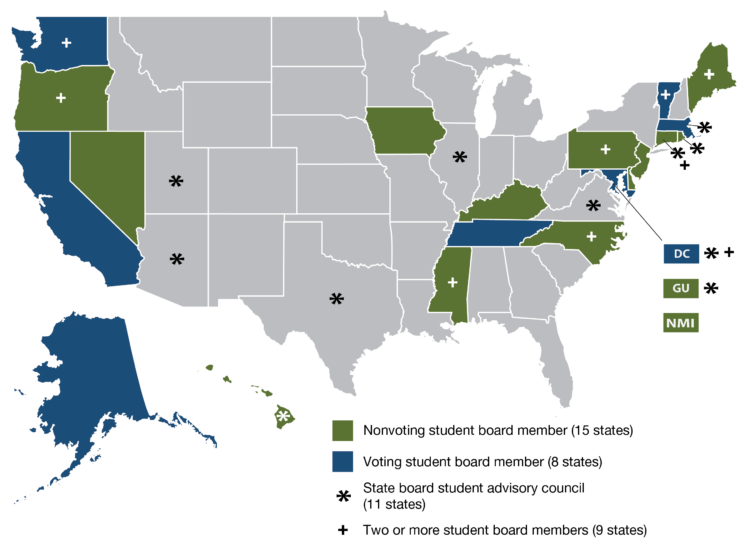
Student board members’ terms are short, often only one year, in a role with a steep learning curve for students and adults alike. Student terms thus do not allow much time to adjust and participate comfortably. When students do engage in policy debates as board members, they are usually the sole young person in a room filled with adults who possess more experience and authority. While this position can be intimidating and may thus serve to mute student voice, board policies can overcome the barriers to students’ full participation.
1 Why have a student on the state board?
Students bring firsthand experience that is essential to making well-informed, student-centered decisions. When given the chance to serve as state board members, they are uniquely positioned to help ensure that policies and actions achieve excellence for all learners, including peers whose perspectives may often be overlooked. Students are education’s most important stakeholders, yet they are rarely at the table where consequential decisions are made. Student board membership not only adds a young voice to the room, but it also ensures that the people that board policy affects most directly have a formal role in shaping it.
Student board membership not only adds a young voice to the room, but it also ensures that the people that board policy affects most directly have a formal role in shaping it.
“By speaking up, student members help the board see if a new or existing policy or program works and how well,” said one adult board member from Hawaiʻi in an open response to a survey NASBE conducted in 2026. “They act like a bridge between the leaders and the schools. This helps the board make better choices that make sense for everyone.”
For state boards without a student member, simply inviting students to present and speak in front of the board regularly may seem like a reasonable alternative, but these inclusions can easily be forgotten during board turnover or passed over for other time-consuming matters. Having a student board member, however, creates a long-term position that will better withstand political shifts and create a more permanent space for student voice.
2 How can we strengthen student representation on our board?
Most student board members serve in an advisory capacity. They are the lone student on their boards and usually have only a one-year term. A single student board member may struggle to convey the spectrum of student experience in geographically and demographically diverse states. Acknowledging this, some states have broadened channels for student voice and participation.
As of 2026, eight states allow more than one student to serve on the board. For example, in North Carolina, students serve two-year terms beginning their junior year so that one junior and one senior serve simultaneously.[1] This overlap builds institutional experience as well as broadening the range of perspectives the board hears.
As of 2026, eight states allow more than one student to serve on the board.
The District of Columbia has gone a step further. Four student members serve on the DC State Board of Education, marking a significant youth presence in board discussions and deliberations.[2] The DC bylaws specify that at least one of these members must reside or attend school in historically underserved communities in the District, ensuring that student membership reflects the city’s actual student population rather than only its most advantaged ones.[3]
DC’s student members also co-chair the board’s Student Advisory Committee, which meets monthly to discuss policy matters before the board.[4] In fact, every resolution the board considers must first be presented to the student committee to get their feedback before being placed on the board agenda. The student board members are responsible for reporting committee feedback to the board, in addition to raising any other notable points of discussion from the student committee, channeling a wider range of student perspectives beyond those serving on the board.
Recently, the student committee has expanded their role in District education policy, joining the Urban Institutes’ DC Education Research Collaborative,[5] where members conduct research and data analysis on issues most relevant to District students. Their findings inform evidence-based recommendations that can influence board actions.[6] The pairing of a student board member with an advisory council likely offers boards the most robust student engagement, regardless of the number of student board members.
3 What processes should we use to identify and select a student member? What should our criteria be?
Selection processes for student board members vary considerably across states, but most share a core set of eligibility requirements:[7]
- enrollment in a public school within the state;
- standing as a high school junior or senior;
- good academic standing, sometimes defined by a GPA requirement; and
- a demonstrated ability to attend board meetings and prepare for them.
Balancing board membership with the demands of high school often requires sacrifices, especially for the students who are most likely to pursue these types of leadership opportunities. Many student board members find themselves reducing advanced coursework or limiting extracurricular participation in order to allocate sufficient time and energy to the role. That is not a small ask for a high schooler, and students deserve to understand it clearly before they commit. The Washington State Board of Education website offers prospective student board members ample information on the responsibilities of service, including a recorded webinar hosted by former student board members, an informational brochure, and student testimonials.[8]
Balancing board membership with the demands of high school often requires sacrifices, especially for the students who are most likely to pursue these types of leadership opportunities.
To honor the academic sacrifices student board members often make, boards may offer course credits or similar rewards. The Mississippi State Board of Education allows student members to complete a capstone project during the second year of their term, which they present to the board and other organizations to receive academic credit.[9] This opportunity not only compensates the student board member for the constraints board service may place on high school course taking, it also provides an opportunity to develop unique skills that will bolster their resumes and college applications.
State boards should consider factors related to eligibility criteria that may impact a student’s ability to participate fully. For example, grade-level requirements for student board members may increase the conflicts between service and school. In Kentucky, the student board members serve during 11th grade.[10] For many students, this is their last chance to take high-level courses to impress college admissions teams. Junior year is also when students prepare for and take the SAT and ACT. Students may be more willing or able to adjust their schedules and workloads during their senior year. Grade-level requirements are an option for state boards that wish to minimize the risk of creating unmanageable workloads for students. It is worth noting that for some students, representing their peers is worth the trade-offs, and creating additional eligibility requirements may deter otherwise exceptional candidates.
State boards should consider factors related to eligibility criteria that may impact a student’s ability to participate fully.
The DC state board has avoided setting academic eligibility requirements, even as they receive an often overwhelming number of student applications yearly. According to Executive Director Bernice Butler, this reduces barriers to entry for groups of students who also deserve to be heard but are often left out of the conversation.[11]
“We don’t want [appointments] to be based on whether or not [a student] can get the most recommendations from … teachers or … have the highest grade point average,” Butler said. Rather, the DC board opts to select students who “have a point of view that other students share that needs to be heard,” she said.
Beyond eligibility requirements, boards should consider how their selection process may affect which students are elevated. Application processes vary widely. Some require written essays, interviews with state officials, and formal nominations before a final appointment is made by the governor, the state superintendent, or the board itself. Each recommending and appointing authority may apply different selection criteria or biases, which can influence who ultimately serves. For example, the Kentucky State Board of Education makes a final selection from three candidates recommended by the Commissioner’s Student Advisory Council.[12] Due to the heavy influence of a student-led stakeholder group, these nominations may favor candidates who are more representative of the current student population as opposed to an appointment made solely by the governor’s office or the state board itself. Understanding how a state’s process works in practice can help boards identify where adjustments may be needed to encourage a more representative selection.
Beyond eligibility requirements, boards should consider how their selection process may affect which students are elevated.
Boards committed to reflecting their student populations should consider specific provisions to their selection criteria or bylaws that promote diverse selection. DC’s residency requirement is one example, but state boards must look internally to decide how best to diversify student representation. Without intentional design, selection processes tend to favor students who have been well represented historically.
4 What consent, age-related, or other legal requirements must be considered? What authorities should a student board member have?
State boards considering student membership should first carefully review relevant statutes. Several legal questions commonly arise.
The voting authority of student members is often debated. Most student board members serve in an advisory capacity and cannot vote. Some state statutes explicitly prohibit it. In Delaware, for example, state statute dictates that “an individual who is already subject to the state board’s authority may not be appointed to the state board as a voting member.”[13] The Delaware General Assembly addressed this when it created the position in 2018, writing the nonvoting limitation into the new legislation.[14]
The voting authority of student members is often debated. Most student board members serve in an advisory capacity and cannot vote. Some state statutes explicitly prohibit it.
Even when students are barred from voting, some states have found ways to award students some privileges. In Alaska, students may cast advisory votes, which are recorded but do not influence board decisions.[15] In DC, student members have full voting rights within committees, while votes during a full board meeting also are only recorded. These workarounds give student board members a structured form of participation without violating state statutes or regulations.[16]
Some states have extended voting rights to student members, however. In California, student board members hold the same voting power as any other board member.[17]
Possible conflicts of interest have been raised when state boards consider adding a voting student member. Washington addressed this concern by requiring student board members to recuse themselves in matters that pertain to graduation requirements affecting their school and graduating class.[18] States boards should develop appropriate recusal guidelines for instances in which student members may have a direct stake in the outcome of a vote.
Maturity has also been raised as a concern. In response, Vermont allows student members to vote only during the second year of their two-year terms.[19] This stipulation ensures that the student has the necessary knowledge and experience as a state board member to make informed decisions.
Age and public office requirements must be considered as well. State statutes or constitutional provisions may establish minimum age requirements for holding public office. If board membership is classified as a public office, such provisions may bar students from participating entirely even in a nonvoting capacity. Boards should work with state legal counsel to determine how classification designations or other statutory barriers impact student service and to come up with workarounds, such as an ex officio or advisory designation.
5 What structures and supports can we put in place to build the student member’s knowledge, confidence, and sustained engagement?
For a student member to be successful in their role, the state board must enable their active, productive participation. Many state board members raise concerns about the disruption board service may cause to students’ own schooling. The time commitment often conflicts with school calendars, in some cases requiring students to miss two or more school days per month.
For a student member to be successful in their role, the state board of education must enable their active, productive participation.
While this hesitation on the part of state boards is understandable, it can be addressed. Mississippi students applying to serve on the board must submit a recommendation from a school administrator and also provide written approval from their principal or district superintendent.[20] This step helps ensure that student board members have prior permission to miss school or other educational commitments to attend board meetings and perform other board responsibilities.
Washington’s state board staff work directly with students, parents, and schools to coordinate excused absences, arrange travel to board meetings, and reimburse travel costs.[21] Washington also offers stipends to student members, recognizing that there are sometimes financial constraints that may limit a student’s participation.[22]
Beyond seeing to logistics, state boards must prepare a student for their role and responsibilities. Kentucky assigns a sitting state board member as a mentor to the student representative.[23] An effective mentor must be an ongoing point of contact for navigating board culture, understanding agenda items, and building the confidence to participate fully. Well-developed orientations and training for student members help prepare them for effective board membership, especially when they occur early in the students’ terms or even before their official start dates. Ongoing training can ensure that students are successful throughout their terms and support their growth as leaders.
Boards can also help student members take initiative that extends beyond their formal responsibilities. When Ian House served as the North Carolina state board’s student advisor, board members and staff at the North Carolina Department of Public Instruction supported him in launching the Student Voice Alliance to strengthen student representation in state-level education policymaking.[24] Their support enabled House to develop skills in survey design and program implementation, and he presented to the board on multiple occasions about the work.
Boards can also help student members take initiative that extends beyond their formal responsibilities.
“When student board members are provided the opportunity to present on their work, it enables it to not collect dust, but rather for it to be broadcast across the state and receive meaningful feedback from board members and the listening public,” House said.
House’s work on the Student Voice Alliance attracted the interest of a Hawai‛i’s student board member, which led to the launch of a cross-state ambassador program pilot.[25] Thus, House’s impact increased as a consequence of adults around him being invested in his success.
Boards must prepare student members for the realities of public-facing service. Student board members often give public testimony, appear in recorded meetings, and engage with adult and peer constituents and the media. Public communication and media training are essential not only for student board members but also their mentors and support staff to ensure that they are well equipped to guide students effectively.
Public communication and media training are essential not only for student board members but also their mentors and support staff to ensure that they are well equipped to guide students effectively.
Boards must also acknowledge that student members may experience inappropriate or unprofessional interactions. A local Tennessee school board meeting made headlines in 2026 when an adult board member physically pulled a student against him and made an inappropriate comment during the meeting, highlighting the need for formal procedures to address inappropriate behavior and ensure students’ safety and well-being.[26]
Due to their youth and perceived lack of experience and authority, student board members sometimes face unprofessional behavior from adult board members and staff. Boards should establish clear protocols for how staff will respond when a student member is dismissed, talked over, or treated inappropriately in a public setting, and student members should be aware of those protocols before they are ever in a situation that requires them. Mentors, staff liaisons, and board chairs all serve a critical role here. They ensure that the student member feels supported: Student members should be able to count on someone in the boardroom who is looking out for their best interests.
Effective student board membership requires active, ongoing investment. Boards that build mentorship, logistic supports, and clear protocols into their membership structure make it possible for student members to engage substantively and contribute on an equal footing to the adults in the room.
Caroline Flower is project and administrative support associate at NASBE.
Notes
[1] North Carolina General Statute, § 115C-10.
[2] District of Columbia State Board of Education, “D.C. State Board of Education Bylaws,” February 21, 2024.
[4] “Student Advisory Committee,” District of Columbia State Board of Education, web page.
[5] The DC Education Research Collaborative, web page.
[6] Student Advisory Committee, “SY25-26 Student Advisory Committee Annual Report,” District of Columbia State Board of Education, report.
[7] Celina Pierrottet, “Engaging Youth in Education Policymaking,” Policy Update 29, no. 6 (August 2022).
[8] “Student Board Members,” Washington State Board of Education, web page.
[9] Mississippi State Board of Education Policy Manual, Part 2 Chapter 2 Rule 2.3.
[10] Kentucky Administrative Regulations, Title 701 Chapter 5:160.
[11] NASBE, “How States Can Inspire Student Civic Engagement,” YouTube, October 16, 2025, video.
[12] Kentucky Administrative Regulations, Title 701 Chapter 5:160.
[13] Delaware Administrative Code, Title 14 § 104.
[14] Delaware, An Act to Amend Title 14 Of the Delaware Code Relating to the State Board of Education, House Bill No. 455 (2018).
[15] The Alaska State Board of Education and Early Development, “Bylaws of the State Board of Education and Early Development,” September 15, 2018.
[16] DC state board, “Bylaws.”
[17] California Education Code, Title 2 Division 2 Part 20 Chapter 1.
[18] Revised Code of Washington, Chapter 28A.305.
[19] Vermont Statute, 16 V.S.A. § 161.
[20] Mississippi State Board of Education Policy Manual, Part 2 Chapter 2 Rule 2.3.
[21] Washington State Board of Education, “Student Board Members,” web page.
[22] Washington state board, “Student Board Members,” web page.
[23] Kentucky Department of Education, “Kentucky Board of Education Nonvoting Student Member,” web page, March 4, 2026.
[24] Student Voice Alliance, “Connecting Students with Education Policies,” web page.
[25] Student Voice Alliance, “Ambassador Program,” web page.
[26] Marlene Lenthang, “Tennessee School Board Member Who Called Student ‘Hot’ is Censured,” NBC News, April 8, 2026.

 i
i
 i
i