States Elevate Math, Career Education in New Round of Strategic Plans

In 2025–26, 18 states adopted or revised a strategic plan for education. Most stayed focused on postsecondary readiness, educator retention and recruitment, and student academic achievement. However, several of the newest plans add emphasis on math learning, workforce readiness, and technology use in schools.
NASBE published its first review of the strategies, goals, and objectives of 49 strategic plans, including those in the District of Columbia and Guam, in June 2024.[1] The plans that were new then reflected pandemic-related concerns: learning recovery, student mental health, chronic absence, and digital learning. Many of these plans remain in effect.
Goals and Strategies
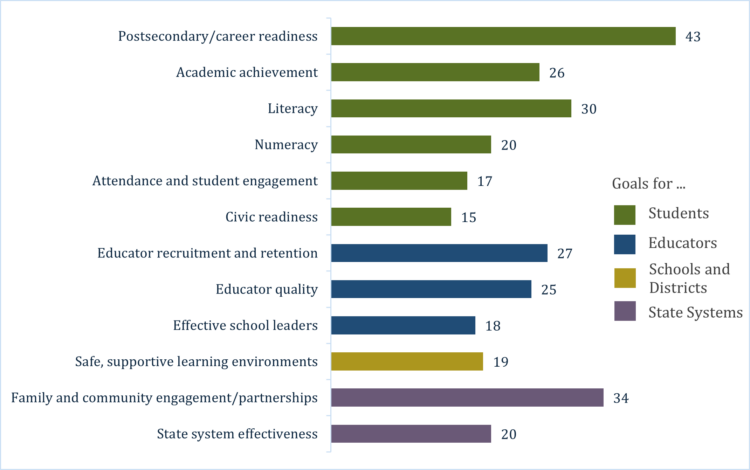
In this update of states’ strategic plans, state policymakers’ top goal for students is college and workforce readiness, included in 43 plans and parsed into a range of strategies and metrics (see figure). Twenty-six plans highlight goals for academic achievement generally, while 30 states set goals for literacy and 20 for math proficiency. Regarding the goals for educators, 27 states fixed on teacher recruitment and retention and 25 on educator quality and effectiveness. The top goal for schools, mentioned in 19 plans, was creating safe, supportive learning environments, and 34 plans prioritize family and community engagement and partnerships.
Forty-Nine States Set Strategic Plans for Education
Math and Numeracy
While many states have been stressing the need for progress on literacy outcomes, including 30 current plans, 20 states also include goals for improving numeracy. Of these, 14 are state plans that were adopted or revised in 2025–26. The urgency for improving math outcomes is not surprising, given the 2022 dip in already-declining student math performance on the National Assessment of Educational Progress (NAEP) as well as widening gaps among student groups.[2]
Kentucky’s plan seeks improved early numeracy rates, targeting a proficiency rate among Kentucky third graders of 55 percent by 2029 and a level that exceeds pre-pandemic performance in 2027. A number of strategies underpin this goal: building district capacity to design engaging, rigorous math learning opportunities; teacher and leader academies with targeted professional development; high-quality math curriculum and instructional resources; and tailored support that includes screeners and math improvement plans for individual students.[3]
Iowa’s plan sets a goal of increasing the percentage of grade 3–11 students “who demonstrate grade-level mathematics knowledge, skills, and attributes” through the state summative test from 69.5 percent in 2023 to 82 percent in 2029. It also identifies targets for increasing proficiency and reducing achievement gaps as measured by the state’s ranking on NAEP tests.[4]
North Carolina will also gauge its progress against NAEP and, citing the success of its focus on evidence-based reading instruction, seeks to launch a parallel focus on foundational mathematics to support early learning.[5]
Tennessee plans to “expand high-quality math pathways … and investigate opportunities for more advanced math course enrollment in middle school to ensure students are prepared for advanced math in high school.”[6]
Workforce Readiness
Rooted in a desire to make education more engaging and relevant for students, many states put career and workforce readiness measures into their strategic plans. Forty-three states, including all 18 that revised or adopted their plan in 2025–26, focused on postsecondary readiness, with many targeting work-based learning, apprenticeships, career exploration, career and technical education, and industry-recognized credentials.
Forty-three states focused on postsecondary readiness, with many targeting work-based learning, apprenticeships, career exploration, career and technical education, and industry-recognized credentials.
Missouri’s 2023–26 plan, updated in 2025, highlights the role of individual career and academic plans to guide students toward personal career goals. It also tracks the number of students earning industry-recognized credentials and participating in registered youth apprenticeships.
In its 2025–28 plan, Colorado aspires to help districts provide multiple pathways for workforce readiness aligned to student interests and goals. The plan highlights state guidance on apprenticeship, microcredentials, internships, certificates, and diploma endorsements.[7]
For some states, life skills and competencies are core to postsecondary success. Utah’s strategic plan refers to its Portrait of a Graduate to outline how each grade level can support student competencies ahead of graduation, highlighting not only academic mastery but communication, critical thinking and problem solving, creativity and innovation, collaboration and teamwork, and other durable skills.[8]
Eight states included military readiness in their priorities or goals, often tagging it alongside their workforce initiatives. Indiana included preparedness for military enlistment in its Graduates Prepared to Succeed dashboard. Georgia’s focus on real, relevant education extends to military service and explores how career, technical, and agricultural education programs open options for students’ futures.[9]
Eight states included military readiness in their priorities or goals, often tagging it alongside their workforce initiatives.
Technology in Schools
Although officials in many states have set up task forces and adopted guidelines related to technology use in schools over the past few years, relatively few K-12 strategic plans include goals for improving students’ data literacy, using new artificial intelligence (AI) tools to improve teaching and learning, or preparing schools to address risks from inappropriate uses of AI or threats to student data privacy.
There are exceptions. Delaware’s department of education released a plan in April 2026 that dubs AI proficiency a priority under its goal to provide fair opportunities for every learner. It aims to have three-quarters of districts and charters using AI tools to improve student outcomes and help educators manage their workloads. In addition, the plan aims to “provide clear guidance on media literacy and safe, responsible, and ethical use of generative AI for educators.”[10]
As part of the Tennessee state board’s goal of ensuring that its members engage with the community and are accountable for effective implementation of its rules and policies, their plan commits the state board to determining “the state-level resources and guidance needed to effectively and ethically leverage Artificial Intelligence to propel student learning.”[11]
In a plan it approved in 2023, the Connecticut state board vows to “collaborate with various stakeholders to explore how the emergence of a vast array of artificial intelligence tools might influence the nature of curriculum design.” It stresses the need to “serve students who will live, learn, and work in an era of revolutionary technologies.”[12]
Virginia’s plan emphasizes use of technology to enhance learning and prepare teachers to take advantage of AI while maintaining standards of academic integrity. The plan also includes goals for furthering the safe use of media and the internet and for expanding innovative virtual learning experiences.[13]
Developing a Plan
State boards have also revisited their processes for plan development. In February 2026, Tennessee adopted a strategic plan for 2026–28. After noting the overly ambitious goals in prior plans, the state board overhauled its process in 2021, moving from a five-year adoption cycle to every three years and committing to annual progress reports. In its new plan, the state board built on previous focus areas, such as literacy, to address areas of growing policymaker interest, including numeracy and teacher and school leader quality.
Core to Tennessee’s process was identifying stakeholders and partners and streamlining plan development through committee assignments. “Define who your stakeholders are and have those groups at the table when drafting, overhauling, or updating your strategic plan,” said Ali Reid, chief of strategy on the state board. “That also means community leaders, because when you think of who’s impacted by the goals in your plan, you also need to consider who is supporting the work that is happening in your school communities.”
“Define who your stakeholders are and have those groups at the table when drafting, overhauling, or updating your strategic plan.”
Reid also highlighted the value of appointing a committee to lead the work. “Trying to have in-depth conversations about goals, actions, and data with your full board on a tight timeline can be hard to coordinate.”
Each November, the Tennessee state board reports progress on implementation of the master plan, providing a chance to make adjustments. “It also provides an opportunity to engage in an open and honest discussion about what is working well and where we are facing challenges as a state,” Reid said. “This level of transparency is essential for making meaningful improvements as we identify both our successes and gaps in the data.”
Joseph Hedger is NASBE’s program manager and editor and Valerie Norville is editorial director.
Notes
[1] Joseph Hedger and Valerie Norville, “New State Strategic Plans Zero In on Learning Recovery,” Policy Update 31, no. 1 (June 2024).
[2] Paolo DeMaria and Valerie Norville, “Leaders Back Statewide Plans to Improve Math Learning,” Policy Update 33, no. 3 (May 2026).
[3] Kentucky Department of Education, “United We Learn: Strategic Plan, 2024–2029” (December 2023).
[4] Iowa Department of Education, “Strategic Plan, 2025–29” (2024).
[5] North Carolina State Board of Education and Department of Public Instruction, “Achieving Educational Excellence, 2025–2030: Strategic Plan for North Carolina Public Schools” (August 2025).
[6] Tennessee State Board of Education, “Master Plan for Public Education: Three-Year Plan from 2026 through 2028” (February 2026).
[7] Colorado Department of Education, “Start Strong, Stay Engaged, Leave Ready! CDE’s 2025–2028 Strategic Plan.”
[8] Utah State Board of Education, “Board Strategic Plan” (October 2025).
[9] Indiana Department of Education, “Indiana Graduates Prepared to Succeed,” webpage; Georgia Department of Education, “Who We Are,” webpage.
[10] Delaware Department of Education, “Strategic Plan 2025–2028.”
[11] Tennessee state board, “Master Plan.”
[12] Connecticut State Board of Education and Connecticut State Department of Education, “Every Student Prepared for Learning, Life, and Work beyond School: The Comprehensive Plan for Education, 2023–2028” (August 2023).
[13] Virginia State Board of Education, “Board of Education Comprehensive Plan: 2024–2029 (December 2023).
 i
i
 i
i