
States’ Role in Transforming High School: Evidence, Trends, and the Path Forward

High school sits at the intersection of everything states want for their young people: academic preparation, economic opportunity, civic participation, and personal development. Yet many young people say high school is not working for them. As many as three in four Generation Z high school students report feeling unprepared for life after graduation.[1] The adults closest to them are also concerned. About a third of teachers think their students are not ready for what comes next.[2] Increasing numbers of parents say they want high school experiences to help their students chart pathways toward a meaningful future.[3]
Three in four Generation Z high school students report feeling unprepared for life after graduation.
In 2024, the National Association of State Boards of Education (NASBE) invited high school students serving on their state boards to describe their high school experiences. Student board members from Guam reported that many of their peers saw no connection between their schools and their communities. Student board members from Maine, New Jersey, Delaware, and Nevada reported general student disengagement, which they traced to state and district policies, such as graduation requirements disconnected from the skills and knowledge students need to be successful in a modern economy.
These perspectives underscore the structural issues arising from a creaky system that was built for another time. Rather than blindly accepting schooling that feels out of touch with their lived realities, students disengage from learning and fail to attend regularly.[4] These warning signs that the traditional high school is no longer working for most students have caught state policymakers’ attention in recent years. The student advisors offered a clear solution: Students need to see relevancy in their education and a clear line between what they are learning and where they are headed. While schools and educators ultimately create and manage the environments that engage and educate students, state policymakers have numerous levers they can use to incentivize high schools to transform and become what students need to learn and thrive in high school and beyond.
Students need to see relevancy in their education and a clear line between what they are learning and where they are headed.
A Cross-State Network and Advisory Groups
NASBE has partnered with KnowledgeWorks over the past two years to facilitate the High School Transformation State Network (HSTSN). Convening cross-agency teams led by state boards in California, Indiana, Kentucky, Missouri, and Washington, this two-year policy learning community has unpacked the state’s role in transforming high schools. Each participating state established a team comprising state board members, state education agency staff, and representatives from higher education and workforce development agencies.
State teams engaged in communities of practice with subject-matter experts, participated in cross-state surveys and convenings, and received direct coaching and technical assistance. Representing decades of research and work on promising practices, a Network Advisory Council of national experts in high school transformation, competency-based learning, and education policy informed the state teams’ work. A complimentary Student Advisory Council centered student voice, grounding the work in the lived experiences of current high school students. Together, the network and the councils provided real-world perspectives and evidence.
What Does a Transformed High School Look Like?
Most American adults have an expectation of what high school should look like based on their own experiences. Students attend schools five days a week, with uniform start and end times built around a 180-day calendar and schedule grounded in a college-preparatory curriculum that progresses through age-defined cohorts. At the end of an academic year, a student earns credit for the courses they completed based on time and academic proficiency. Once a student earns the number of credits mandated by the state and school district, they earn a high school diploma. This model has not changed much for over a century. Even though most American adults experienced this brand of high school themselves, it runs counter to the needs of today’s students, as well as communities recovering from COVID-19 and grappling with how artificial intelligence will reshape the workforce.
Even though most American adults experienced this brand of high school themselves, it runs counter to the needs of today’s students.
Our student advisors told us they want relevant learning, meaningful college and career pathways,[5] agency over their learning, and a clear connection between school and their futures. These desires speak to what is missing from today’s high schools and map closely to what researchers and practitioners have identified as hallmarks of a transformed high school experience. In partnership with our two advisory councils, NASBE and KnowledgeWorks reviewed existing frameworks, all of them based on decades of research and the science of learning and development, and derived a set of common elements of a transformed high school.[6] We organized them into three areas: school organization, exceptional learning experiences, and policy context and support.
School Organization
- A transformed high school has a student-centered statement of purpose or vision that clearly articulates the knowledge, skills, and dispositions it wants students to have by the time they graduate.
- The school culture aligns with its shared vision and supports student belonging, excellence, and accomplishment.
- Educators and school staff are equipped to effectively deliver student-centered instructional strategies, and the school prioritizes team-based approaches and collaboration.
- School and community leadership are committed to the school’s purpose and vision, and school staff are equipped with the skills in change management and continuous improvement necessary to achieve the school’s purpose and vision.
- Systems support cycles of continuous improvement, which drives the school closer to its purpose and vision.
Exceptional Learning Experiences
- The school embodies a student-centered design, with students co-creating their learning experiences and advocating for their needs.
- Students engage in meaningful learning experiences in and outside the school building.
Policy Context and Support
- Districts and states, working together, support transformation at the local level.
State policy environments shape the decisions school leaders make about vision, instructional design, and student pathways. In many cases, state policy constrains these leaders. Carnegie unit and credit-based graduation mandates, along with accountability systems designed around seat time rather than demonstrated learning, all push schools toward familiar structures even when leaders want to build something different.
State policy environments shape the decisions school leaders make about vision, instructional design, and student pathways.
Given their place at the center of US K-12 policy, states are primed to play a major role in this work. National surveys indicate that every state has some policies in place that support high school transformation.[7] Yet these efforts have inspired only incremental change at the school and district level, underscoring that transforming high schools is a long-term undertaking. It demands sustained political will, coherent policy alignment across agencies and sectors, and institutional structures to sustain change through leadership transitions, budget cycles, and competing priorities.
State boards are well positioned to lead this charge. Their members represent diverse professional and community backgrounds and bring a citizen perspective to policymaking, grounding high school transformation in the communities they serve. That same breadth of connection makes state boards natural conveners who can gather educators, higher education leaders, workforce partners, and community members around a shared, long-term vision for change. Although they cannot do this work alone, state boards can establish and operationalize a statewide vision, align policy across agencies, elevate promising practices from schools and districts, and make the public case for why transformation matters.
State boards can establish and operationalize a statewide vision, align policy across agencies, elevate promising practices from schools and districts, and make the public case for why transformation matters.
Network State Trends
Each state in our network approaches high school transformation from a distinct starting point. However, we identified five cross-cutting trends. These trends draw on a survey conducted between March and May 2025, community of practice sessions, and direct engagement with state teams. Each trend surfaces both the progress states are making and tensions they have not yet resolved.
1. Building Coherent Systems through Cross-Sector Partnership. High school sits at the transition from childhood into adulthood and what comes next, be it college, the military, or the workforce. A variety of state entities govern these pathways. Effective high school transformation requires strong coordination among them to develop the definitions, programs, and consensus on shared outcomes needed for meaningful, lasting change.
Effective high school transformation requires strong coordination among them to develop the definitions, programs, and consensus on shared outcomes needed for meaningful, lasting change.
Nowhere is this more apparent than in cross-agency data systems. HSTSN states consistently emphasized the need for systems that incorporate K-12, postsecondary, and workforce outcomes. They see such systems as crucial to enabling schools, districts, and states to assess student outcomes, identify what is and is not working, and respond appropriately. The data generated in such systems informs K-12 policy, builds research and development cycles to drive continuous improvement, and helps stakeholders—including students and families—develop a shared understanding of college and career readiness and success.
Through their network activities, several HSTSN states took steps to advance such collaboration. The Kentucky Board of Education convened a High School Transformation Work Group that includes state board members, the commissioner of education, executive and legislative branch leaders, and leaders from the chamber of commerce and postsecondary agency. This group has worked to identify barriers and align policy levers across systems in areas like nurturing innovation zones, supporting teachers in transitioning to skill-based assessment systems, and developing alternatives to the traditional transcript. In January 2026, the Kentucky United We Learn Council began discussing how its work reimagining assessment and accountability could spark broader high school transformation.[8] Anchoring this work within a more permanent council, rather than a temporary work group, draws on the council’s track record of advancing systems change and reduces the risk that progress will stall due to leadership turnover or shifting priorities.
California established the California Education Interagency Council to align K-12 education, higher education, and workforce systems around a shared vision for student success.[9] It coordinates efforts related to college and career pathways, workforce alignment, and postsecondary transitions, with the goal of reducing fragmentation across historically independent systems. The state also designed its Cradle to Career Data System to connect data across the continuum. In 2025, the state released an initial public-facing tool, the Student Pathways Dashboard, which tracks college enrollment, degree attainment, and employment outcomes. Over time, California will release more data elements to simultaneously drive decision making via the interagency council and to align funding for new and existing education programs with labor market demands.
Washington’s Future Ready Initiative convenes the Washington State Board of Education, Office of Superintendent of Public Instruction, Student Achievement Council, State Board for Community and Technical Colleges, and Workforce Training and Education Coordinating Board to align graduation requirements with postsecondary admissions and workforce expectations and strengthen career-connected learning. This cross-sector task force has partnered with students, families, employers, and community organizations to develop recommendations for revised high school graduation requirements that align to the state’s profile of a graduate. By the end of 2025, the task force had begun developing recommendations to propose to the legislature in 2027, some of which would better align the state’s minimum graduation requirements, college admission requirements, and a statewide mastery-based crediting policy.[10]
2. Defining Desired Outcomes. Every HSTSN state agreed that students should develop knowledge, skills, and dispositions that will prepare them for success in an uncertain future. Portraits of a graduate that define the durable skills needed for this future represent a key strategy for accomplishing this.[11] The portraits extend learning goals beyond traditional academic subject areas and typically define six to eight skills such as critical thinking, communication, creativity, and collaboration. Often, a framework and aligned resources help teachers incorporate each trait into instruction at different age ranges or grade bands. To date, 23 states have adopted portraits or portrait-like documents in policy (figure 1).
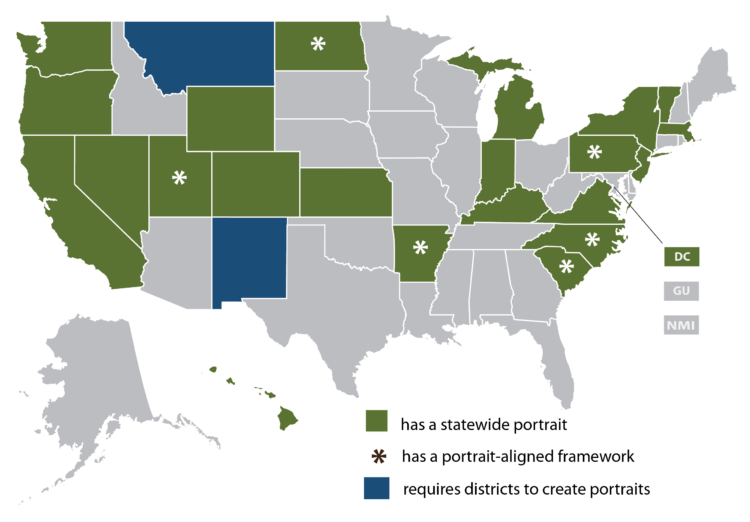
Source: KnowledgeWorks and FullScale, “State of CBE,” web page (2026); additional research by authors.
State boards are in a prime position to advance statewide portraits of a graduate. For example, nearly 160 of Kentucky’s school districts—more than 90 percent—have voluntarily adopted a local portrait of a graduate aligned with Kentucky’s Portrait of a Learner, adopted by the Kentucky Board of Education in 2022.[12] After extensive public engagement, the California State Board of Education approved a state portrait of a learner in May 2026 that includes competencies, such as multilingualism and multiple literacies, and aligns its definition of student success with broader goals for college, career, and civic readiness.
However, a statewide vision is not enough. Aligning instruction to portraits is a major shift for educators, and many states fail to develop the resources needed for effective implementation. For example, of the 23 states with a portrait, only six have aligned statewide competency frameworks, which are typically presented as a set of competencies and progressions that express interrelated knowledge, skills, and dispositions that are relevant, measurable, and transferable and that can be applied throughout a learner’s lifetime (box 1). In their absence, portraits become aspirational rather than actionable.
Box 1. Personalized, Competency-Based Learning
Transformed high schools provide academically rich, rigorous learning opportunities through competency-based instruction, in which student learning is personalized and academic achievement is measured against a set of progressions toward mastery. Where schools personalize instruction, students hold positive views of the school environment and exhibit achievement growth, most notably in mathematics.[13] Schools where students experience this sort of instruction are more likely to see improved attendance,[14] as well as academic performance.[15]
Capturing evidence of portrait impact represents another major challenge. While portraits emphasize widely agreed upon skills developed in close collaboration with communities, systemically assessing and reporting on whether students have mastered these skills is much more challenging. HSTSN states grappled with this challenge and emphasized the need for leaders to signal the important shift from “teaching content” to “teaching skills through content” by making relevant changes to policy.
HSTSN states … emphasized the need for leaders to signal the important shift from “teaching content” to “teaching skills through content.”
Indiana shows how states can tackle this challenge. Its leaders have embedded portrait-aligned outcomes in Indiana’s graduation requirements and into a new school accountability model. As a consequence, they are shaping not only a statewide vision but also offering incentives and structures to spur innovation.[16] Indiana’s leaders also built a dashboard around the state’s graduate profile called Indiana Graduates Prepared to Succeed, or Indiana GPS, to report on progress toward goals for K-12 learning and students’ readiness for college and careers.[17] Through Washington’s Future Ready Initiative, the state board has engaged diverse stakeholders to develop high school graduation requirements tied to its portrait of a graduate.[18] Both states are leveraging pilot programs to build proof points and inform scaling.
3. Rethinking Readiness. Postsecondary readiness has historically meant readiness to pursue a four-year college degree. Policymakers today are broadening their approaches and putting college, career, and military readiness on a more equal footing. States predominantly do this through expanding high-quality learning experiences that lead to college credit or industry-recognized credentials (box 2). However, even when these pathways expand, state teams indicated students may struggle to gain access in some places or lack help to navigate available resources. It is also not always clear whether these pathways lead to long-term positive student outcomes, with few states having data systems and research and development structures to track the impact.
Box 2. Exceptional Learning Experiences
Transformed high schools provide relevant, engaging learning experiences both inside and outside the classroom. These experiences enable students to demonstrate state-defined academic knowledge, durable skills, and dispositions articulated in documents like portraits of a graduate. Dual enrollment, early-college high schools, career-focused education such as linked learning pathways, and career and technical education are examples of such experiences. They improve a broad range of student outcomes: increased rates of college enrollment and completion, academic readiness, and employment skills attainment, among others.[19]
Network participants repeatedly underscored the importance of ensuring that pathways are ingrained in the K-12 system rather than an add-on. These pathways and their accompanying learning experiences also need to align to the state’s broader learning goals and need to be supported through strong partnerships with the workforce, higher education institutions, and community organizations.
HSTSN states are undertaking a variety of strategies to strengthen their offerings. Indiana’s revised graduation requirements include seals that students can earn to demonstrate college, career, or military readiness. These seals emphasize rigorous coursework, high-quality work-based learning, and opportunities for students to earn a credential of value before high school graduation. The California State Board of Education has leveraged state diploma seals for students to demonstrate civic engagement.[20]
HSTSN states highlighted individual learning plans as a way to create “permeable connections to college and career” through experiences that are integrated into students’ broader learning trajectories. Kentucky[21] and Washington[22] require individualized learning plans for students and have been reviewing these plans to make them more actionable. Kentucky’s starts in sixth grade. Missouri has coupled its Individual Student Planning as a program component of the Missouri Comprehensive School Counseling Program and provides support to school counselors in the development of this plan through regional career advisors.[23]
Through conversations with key stakeholders, Kentucky identified the individual learning plan as an opportunity to provide structure for personalization and pathway navigation and worked with students to make the tool more relevant. Students from the commissioner’s Student Advisory Council said they appreciated a more flexible tool, but they also highlighted the need for assistance from school staff dedicated to developing these plans effectively. One member of the Student Advisory Council said the plans can “ease [the] postsecondary plan anxiety that students have about picking their pathway and their career in high school.”[24]
Kentucky identified the individual learning plan as an opportunity to provide structure for personalization and pathway navigation and worked with students to make the tool more relevant.
4. Making Student Learning Visible and Credible. States prioritizing durable skills and pathways must create systems to validate and communicate outcomes from expanding these opportunities. But here, aspirations collide with reality. HSTSN states consistently identified assessment and accountability systems as both a critical lever and a constraint, with stakeholders in NASBE’s 2025 cross-state survey identifying assessment and accountability as the top two policies hindering high school transformation.
States prioritizing durable skills and pathways must create systems to validate and communicate outcomes from expanding these opportunities.
Misaligned federal requirements and legacy systems like grade-point averages (GPAs), seat time credits, and standardized tests help foster this view. Some states opt to create parallel state accountability systems to capture more holistic data, which, while valuable, can also cause confusion within schools about what to prioritize. Additionally, postsecondary and workforce systems continue to rely largely on traditional measures that disincentivize the adoption of broader metrics.
Indiana has taken an innovative approach to this challenge. Its leaders developed and validated diploma seals in partnership with employers, institutions of higher education, and the military. These seals signal students’ readiness for enrollment, employment, or enlistment by incorporating both academic achievement and applied experiences.
Despite the challenges, HSTSN states are beginning to move toward accountability systems that better reflect a broader vision of student success, including durable skills, applied learning, and postsecondary readiness. But this shift also requires rethinking the way that states define, assess, and communicate mastery of durable skills (box 3). Aspects like creativity and communication look different across different contexts, making collecting, evaluating, and comparing evidence challenging. And many states establish portraits without common definitions or skill progressions to help students, teachers, and parents understand what mastery looks like, which can cause confusion and prevent innovative practices from taking root.
Box 3. New Signals of Student Learning
Transformed high schools use comprehensive, next-generation assessment systems that capture the full range of skills students need to thrive. Student self-assessment and peer assessment can improve academic outcomes,[25] and performance-based assessments lead to better long-term outcomes, such as development of communication and presentation skills[26] as well as better academic performance and persistence in college.[27]
Policymakers and practitioners have raised concerns about what constitutes credible evidence as well as how to ensure that evaluations of competencies are equitable by design. And these new models often demand significant shifts in instruction, professional learning, and data systems, increasing the burden on educators, in turn creating capacity concerns.
HSTSN states are responding to this tension by iterating performance tasks or portfolios in pilot districts. As part of its participation in the Skills for the Future pilot, in partnership with the Carnegie Foundation for the Advancement of Teaching and ETS, Indiana is piloting portfolio-based testing approaches that capture both academic knowledge and durable skills, with the goal of better connecting these demonstrations of learning to broader state systems.
Indiana is piloting portfolio-based testing approaches that capture both academic knowledge and durable skills.
Indiana state board members had already recognized in 2023 that they needed to pare their learning standards in order for a shift to competency-based instruction to take root, even as they continue to prioritize rigor.[28] At a meeting of the network states, Indiana state board member Scott Bess said teachers felt constrained by the number of standards they needed to teach and that there was not enough time in the school year to adequately teach skill development on top of content. Streamlining the standards freed teachers up to deepen student learning.
Indiana’s state board in 2026 approved a redesigned accountability system that reflects a broader definition of readiness and builds a system “that allows for the opportunity to rethink high school,” as Commissioner Katie Jenner put it. [29] The system goes beyond traditional academic measures to include durable skills, work-based learning, and the attainment of diploma seals. Following state board approval, the US Department of Education approved the state’s high school accountability waiver request to align its federal and state accountability systems. The system thus more closely aligns what students are expected to learn, how that learning is assessed, and how readiness is communicated beyond high school. In a report to the state legislature, Washington’s state board and its Mastery-Based Learning Collaborative recommended development of a statewide competency-based transcript.[30] Such a transcript would aim to communicate more clearly to colleges and employers what students have learned and can do, while also requiring crosswalks to traditional systems.
Washington’s state board and its Mastery-Based Learning Collaborative recommended development of a statewide competency-based transcript.
Riding on the heels of California’s recent adoption of a portrait of a learner, the California community college system launched a pilot of a digital career passport to create a more comprehensive record of competencies—one that reflects not only academic achievement but also skills and experiences accumulated through real-world learning, including those gained beyond graduation.[31] This tool is being piloted through community colleges, and there are hopes of connecting it to K-12 to more seamlessly document student learning across P-16.
5. Learning from Pilots and Scaling What Works. To enable schools and districts to try new things and then identify what is working and what is not, HSTSN states are implementing waivers and other statutory flexibilities in areas such as seat-time requirements and competency-based learning.
While important, these flexibilities do not yield changes at scale without additional state supports. HSTSN states emphasize the need for teacher preparation and professional learning to better support competency-based and skills-focused high school models (box 4).
Box 4. Teachers and Leaders
Teachers and school leaders are crucial to high school transformation. Effective school leadership promotes effective instruction, teacher retention, and positive school climates, making principals key drivers in school stability and improved student outcomes.[32] Moreover, teachers in supportive, collaborative environments are better able to build strong relationships with students, which are in turn strongly associated with improved student achievement and decreases in chronic absenteeism.[33] Supports for leadership and staffing are especially important when designing and sustaining high schools focused on competency-based learning.[34]
They also stress the need to learn from innovative approaches in a pilot phase and scale them when they work. As they innovate, state leaders also recognize the need to avoid creating systems that reinforce long-standing inequities like tracking or inequitable access to rigorous coursework.
Emerging out of a working group that the state superintendent charged with making recommendations about furthering competency-based learning in Missouri, the Success-Ready Students Network brings together public schools to advance competency-based mindsets and personalized learning experiences.[35] In parallel, a task force has been exploring competency-based courses and performance assessments.[36]
[Missouri’s] Success-Ready Students Network brings together public schools to advance competency-based mindsets and personalized learning experiences.
Several HSTSN states are pairing policy change with investment in implementation. Washington leaders designed the Mastery-Based Learning Collaborative, which includes dozens of schools, to build educator capacity and test instructional approaches in real-world settings. Meanwhile, they are collecting evidence to inform state policy decisions. Inspired by other HSTSN states, California recently launched a Secondary School Redesign Pilot to support local innovation and elevate existing models that can inform efforts to scale redesign.
Kentucky has complemented its policy shifts with tools and partnerships aimed at supporting local districts, including resources to help translate its statewide vision into classroom practice. The Kentucky’s High School Transformation Work Group has recommended that the Kentucky United We Learn Council focus on creating protected, well-supported environments for high schools to innovate and learn from each other, thereby building the community trust needed to enable transformation.[37]
States also recognize the need to invest in pilot programs long term. Often, schools and districts only need funding to kickstart the work, which can be provided by one-time grants that support staff in building knowledge and structures for sustained transformation. During its three local laboratories of learning cohorts, Kentucky allocated between $25,000 and $75,000, depending on the cohort, to each participating district to build local accountability systems. These allocations, in turn, informed the changes now enshrined in law, creating a statewide structure whereby districts crafting local accountability systems receive a fixed amount of financial support to do so.
Often, schools and districts only need funding to kickstart the work.
In some cases, longer-term investments are required. Washington has supported its Mastery-Based Learning Collaborative through appropriations over multiple legislative sessions. This funding enables the network to provide resources to districts to support high school transformation. It also funded the state board’s efforts to provide statewide professional development and networks to support the spread of best practices.
What Comes Next in the Network States
As states look ahead to busy election cycles in fall 2026 and potentially significant changes to state leadership, there are several opportunities for maintaining the momentum on high school reform. Washington will keep drawing on its robust infrastructure for community engagement to move swiftly and precisely. The six-month turnaround on recommendations for a statewide mastery-based transcript offers proof of what that groundwork makes possible, and the team sees sustained community engagement as essential to long-term, large-scale change. The state board will recommend legislation to formalize changes to its graduation requirements in 2027 that reflect significant stakeholder engagement and advocacy.
Missouri is seeking to bring its many overlapping college and career readiness initiatives into alignment through a unified strategic plan. Once adopted, the plan will give Missouri’s cross-agency work a more durable structure, a clearer mandate, and better alignment between the Governor’s Workforce of the Future initiative and state board priorities.
California’s strategy for sustaining momentum centers on partnerships and generating proof points from pilot programs. By building a cross-sector coalition spanning K-12, higher education, and labor, the state is creating the infrastructure needed to advocate for continued investment and scale what works. The 2026–27 budget includes $50 million to expand the Secondary School Redesign Pilot, in which schools in a network learn from each other, surface common barriers, and inform systemwide transformation. In parallel, a $25 million career passport pilot led by the Community College Chancellor’s Office is developing systems to recognize and communicate skills that students acquire outside traditional credit-bearing coursework, ensuring that the broader coalition’s vision of postsecondary readiness shows up in practice.
California’s strategy for sustaining momentum centers on partnerships and generating proof points from pilot programs.
Kentucky is hoping to build on the momentum from its multiyear assessment and accountability work to enable communities to make vibrant learning experiences accessible to all its students. Similarly, Indiana plans to build on its graduation, accountability, and federal waiver changes to support implementation and scaling in communities across the state. Network participants from Indiana expressed a need to help schools and districts put the flexibility these new policies afford into practice in their contexts.
Barriers to Scaling Transformation
Through our partnership with HSTSN states and the advisory councils, we have identified barriers to transforming high schools at scale. NASBE consolidated these into three categories: mindset, policy, and implementation barriers.
Mindset. Existing assumptions about what high school should look like and what counts as rigorous learning often present as great a barrier to transformation as policy. Stakeholders’ own school experiences deeply shape their expectations for students and schools in the present.
Existing assumptions about what high school should look like and what counts as rigorous learning often present as great a barrier to transformation as policy.
These expectations make it difficult for policymakers, community leaders, and families to reimagine schools and school systems. Without broad system redesign, policymakers may pursue approaches that appear innovative but actually reinforce the status quo. Familiarity with traditional approaches can also lead state education agencies to craft supports and guidance around existing approaches, which further impedes transformation.
Policy. There are also tangible policy barriers. Seat-time requirements based on Carnegie units continue to inform high school graduation requirements, funding is still tied to daily attendance, and state assessment and accountability systems reinforce traditional models. Scholarships are often tied to GPAs, and college admissions offices give added weight to class rank based on GPAs and standardized college admissions tests. Financial aid formulas require reporting of traditional time-based credit accumulation.
Many states have acted to address or remove some of these barriers, which are often so interwoven into existing systems that it takes deliberate action across agencies to address them. Without a concerted effort, scaling innovative high school models becomes difficult, making it easier for schools or districts to snap back to more traditional approaches when leadership changes.
Without a concerted effort, scaling innovative high school models becomes difficult, making it easier for schools or districts to snap back to more traditional approaches.
Implementation. As many states in our network have found, shifting mindsets and policies is not enough. When the people who are charged with doing the transformative work of high school redesign do not understand what change looks like or how to put it into practice, it will not happen. Transformation requires information and technical assistance to support districts. Stakeholders may fundamentally not understand what a transformed high school looks like or how to exercise their flexibility under state policy.
State policymakers play a key role in helping to spread information about opportunities to innovate as well as best practices through networks that foster learning across schools and districts. Innovation also requires shifts to educator preparation, in-service professional learning, and instructional design. Each of these carries constraints, both in terms of how programs are designed and the funding to implement and sustain them.
State policymakers play a key role in helping to spread information about opportunities to innovate as well as best practices through networks.
The question of how to scale transformation equitably adds further complexity. Schools and districts with greater capacity and resources are often the first to adopt new models, while those serving the most underresourced students and with the least capacity to innovate can be left working within traditional structures longer. Without deliberate investment in these districts, statewide scaling risks reinforcing rather than narrowing existing gaps in access to high-quality, transformed learning environments.
To overcome the barriers to statewide transformation, states should collaborate across agencies and sectors, shift mindsets from traditional approaches, and help schools and districts take advantage of available opportunities to innovate.
States should collaborate across agencies and sectors, shift mindsets from traditional approaches, and help schools and districts take advantage of available opportunities to innovate.
Theory of Change
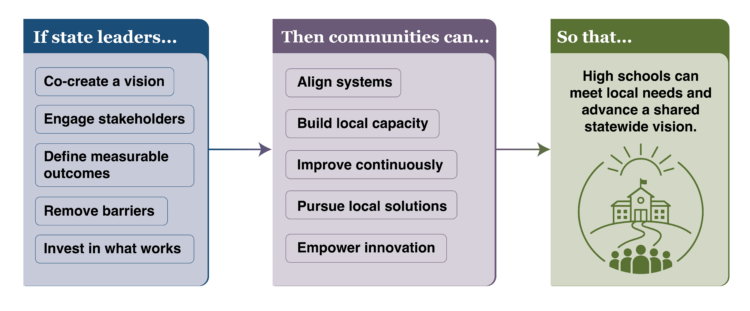
Without policy action and infrastructure support at the state level, promising local ideas rarely scale.[38] Drawing on a review of existing frameworks and insights gained through two years of working with network states, we have developed a theory of change that articulates the state policy conditions that enable communities to transform high schools (figure 2).[39] States enter this work from different starting points, shaped by their own political, historic, and organizational contexts. There is not one set sequence for transforming high schools, but the following conditions, taken together, can create an environment that enables communities to transform their high schools.
State Policy Conditions
- establish and operationalize a vision for a transformed K-12 school system that meets the current needs of students and within which high school plays a key role;
- co-create the vision with diverse statewide stakeholders, including students, families, educators, community leaders, higher education, and workforce stakeholders;
- identify measurable, desired K-12 outcomes as agreed upon by stakeholders;
- remove the policy obstacles that keep legacy models of high school in place; and
- deeply study and understand innovative high school models and target funding and support toward evidence-based practices that advance the state’s overall vision.
Outcomes
- alignment and shared responsibility across the preK-20 and workforce continuum, as well as others engaged with schools (such as health and social services);
- communities empowered to transform high schools through creation of infrastructure and incentives to meet local needs;
- continuous improvement cycles that drive better outcomes over time;
- schools and districts pursuing outcomes aligned with the statewide vision that make sense to their communities; and
- innovative high schools that take root, grow, and scale in line with the state vision.
Priorities for State Policy
We observed consistent patterns among the network states. Setting a vision without the adoption of enabling policy stalls transformation, as does setting policy without providing implementation support. Innovation without continuous learning and improvement fails to scale. Based on barriers they have encountered and lessons they are taking away from states outside the network, our state teams identified five top priorities for their ongoing work that they also recommend other states consider. These action items are grounded in our theory of change and are designed to meet states where they are, regardless of where they are starting from.
Setting a vision without the adoption of enabling policy stalls transformation, as does setting policy without providing implementation support.
1. Operationalize State Portraits of a Graduate. States must first develop a strong vision to anchor their school transformation efforts. Without a vision, shifting mindsets is harder, as is policy development and implementation. This vision is typically embodied in a portrait of a graduate. K-12 stakeholders need to engage higher education and the workforce sectors in crafting portraits in order to ensure cross-sector alignment. State leaders often emphasize higher-order knowledge and skills in portraits. These competencies, along with rigorous academic standards, form the foundation for what students should be able to know and do when they graduate.
K-12 stakeholders need to engage higher education and the workforce sectors in crafting portraits in order to ensure cross-sector alignment.
State leaders, and state boards in particular, must then actively integrate this vision and these competencies in their strategic plans, and they must support governance shifts that prioritize this vision. Such support includes technical assistance to help communities understand how schools can be organized differently, with the portrait as a north star. State board members in particular can leverage their positions to raise public awareness of this vision and its importance, and they can help communities see how it can become actionable in their high schools. State agencies can create resources that help schools and districts understand what transformation can look like and how to make progress.
- South Carolina provides a strong example of how a set of competencies across levels of mastery can make a portrait come to life.[40]
- North Carolina created robust resources to help schools and districts make portraits actionable.[41]
- Montana requires all school districts to create a local portrait of a graduate and provides them with detailed implementation resources.[42]
2. Make Space for Innovation and Continuous Improvement. States must ensure that schools and districts have the freedom to innovate within a state framework that emphasizes learning from high-quality models. First, there must be policies to ensure that schools and districts have the flexibility to innovate.
States must ensure that schools and districts have the freedom to innovate within a state framework that emphasizes learning from high-quality models.
The state-level work does not stop there. States must also tackle policy barriers, including reorienting credit around demonstrated competencies rather than seat time; broadening definitions of when, where, and how learning happens; and allowing more variability in school-day length and calendars. Several states have done so, including these:
- New Hampshire defines credit around competency rather than time.[43]
- Pennsylvania districts can choose to base their calendars around days or instructional hours throughout the year.[44]
Statutory flexibilities are preferable, but states can also create waivers and pilot programs that give schools and districts room to test alternatives. For example, North Dakota’s waiver gives the state superintendent of public instruction broad power to waive statutory requirements.[45] States can then study and elevate promising practices developed through the pilots as they seek to scale successes.
Policies without implementation support are fruitless. Such support includes communications from state leaders aimed at changing mindsets and offering guidance to schools and districts on how available flexibility can help them innovate, which can be accomplished by leveraging peer-to-peer learning networks, supportive staffing within departments, guidance documents, storytelling, and statewide intermediary organizations.
Policies without implementation support are fruitless.
3. Prioritize Relevant, Engaging Learning Experiences for Every Student. Students on our advisory council recognized the critical transition high school represents but also report many disengaged peers who do not see its relevance to their futures. One solution is to ensure that every student selects a clear, definable pathway, no matter their postsecondary goals. State policies can help schools and districts position college, career, and other postsecondary pathways as equally valid routes. Doing so may require state policymakers to revise graduation requirements to ensure that they support the development of college- and career-oriented coursework that treats all pathways as equal.
State policies can help schools and districts position college, career, and other postsecondary pathways as equally valid routes.
States can take action to ensure that students can fulfill graduation requirements through competency-based rather than time-based means and prioritize dual and concurrent enrollment, work-based learning, and career and technical education. States can build longitudinal data systems that connect K-12 with higher education and the workforce to determine which pathways are most valuable to students, and which may need to be adjusted or discarded. And states can rethink transcripts or learning and employment records that connect K-12 to postsecondary and workforce education.
- New Hampshire’s Learn Everywhere program allows approved community-based providers to award credit.[46]
- North Dakota’s graduation pathways align to college preparation, career readiness, or military service.[47]
- Washington, DC, set up the Office of Education through Employment Pathways, which studies whether youth and adults are on a pathway to economic and mobility.[48]
- Texas established the Tri-Agency Workforce Initiative to share workforce and postsecondary data that defines credentials of value and determines which industry-based certifications count toward school accountability.[49]
4. Rethink Assessment and Accountability. Existing state accountability and assessment systems typically encompass just a handful of academic and student outcomes. Though important, their primacy in state systems masks a holistic picture of student readiness for life after high school. While states must operate within federal law, the current administration has signaled an openness to waiving certain provisions in favor of state approaches that can strengthen student outcomes. Absent federal waivers, states have found opportunities for broadening their college and career readiness metrics by examining whether the outcomes their accountability systems prioritize meet their aspirations for students in the K-12, postsecondary, and workforce systems. Stakeholders must collectively ensure that the outcomes that are included in their broader vision for high school transformation also inform their school accountability, assessment, and school improvement systems.
States have found opportunities for broadening their college and career readiness metrics by examining whether the outcomes their accountability systems prioritize meet their aspirations for students.
For example, meaningful college and career readiness metrics—beyond graduation rates and college enrollment—would reward schools and districts whose students demonstrate a broader range of postsecondary successes. A more meaningful system of assessments would minimize the standardized testing footprint to make room for more innovative forms of assessments that give students, families, and educators more real-time, actionable data.
- North Dakota’s Choice Ready metric in its federal accountability system captures a broader range of learning experiences and student readiness.[50]
- Montana and Massachusetts are piloting deeper, more meaningful systems of assessment.[51]
- Colorado incentivizes and supports local accountability systems.[52]
- The New York Board of Regents offers regulatory flexibility that allows schools in the PLAN Pilot to shift from traditional test-based assessments toward multiple performance-based measures to inform the New York Inspires Plan to transform high school.[53]
By streamlining learning standards to reduce the overall number teachers must teach and elevate the most essential ones, state boards can create space for instructional practices that encourage and integrate skill development. All of this information should inform a school improvement system that empowers all schools and districts to innovate and meet meaningful outcomes. States can ensure they receive the necessary technical support and resources to implement innovative strategies.
5. Invest in Educator Capacity to Transform High Schools. States can help teachers, principals, and school counselors build—and thrive within—transformed high schools. Educators conceive and test new education approaches and participate in scaling them across an entire school or district, and they need time, funding, and technical assistance to support their efforts.
State leaders can begin by considering how educator preparation providers train candidates to operate in transformative environments. They can also adopt licensure standards and professional development systems aligned to best practices, such as the science of learning, as well as make sure that teachers and school leaders are trained in student-centered teaching methods. They can remove excessive barriers to hiring industry experts to teach specialized courses.
State leaders can begin by considering how educator preparation providers train candidates to operate in transformative environments.
States often leverage statewide networks or regional organizations for educators’ professional development, and policymakers can ensure that training is geared toward building the skills for effective transformation. The state can also facilitate networks of educators and school leaders to share best practices at the district, school, and classroom level.
- Utah offers a grant program to incentivize districts to foster competency-based learning.[54]
- Minnesota integrates personalization into their licensure standards.[55]
- South Carolina’s PersonalizeSC focuses on professional development to help educators advance personalized learning.[56]
Call to Action
America’s education system is at its best when state policymakers work in partnership with schools and districts to create the conditions necessary for high-quality, bottom-up innovation that can improve student achievement and success in life after high school. This work requires buy-in and engagement from every stakeholder—governments, nonprofits, philanthropy, businesses, districts, schools, families, communities, and students. High school transformation is work worth doing and work that must be done. Our hope is that the leading states highlighted here can illuminate the role states can and should play in creating the conditions for widespread, meaningful change in the design of high school.
Jon Alfuth is senior director of state policy at KnowledgeWorks. Celina Pierrottet is associate program director and Caroline Flower is project and administrative support associate at NASBE.
Notes
[1] YouScience, “2025 Post-Graduation Readiness Report,” report (2025).
[2] Gallup, “Teaching for Tomorrow: Educators on the Future of Their Profession,” report (2025).
[3] American Compass, “Failing on Purpose Survey,” report (2021).
[4] Rebecca Winthrop et al., “The Disengagement Gap: Why Student Engagement Isn’t What Parents Expect,” report (Brookings Institute and Transcend, January 6, 2025); Hedy Chang et al., “Continued High Levels of Chronic Absence, with Some Improvements, Require Action,” blog (Attendance Works, January 16, 2025).
[5] The authors of this report use the definition of college and career pathways created by All4Ed: College and career pathways are aligned sequences of high school courses that integrate rigorous academic learning with hands-on, technical job skills. Developed in partnership with local businesses and industries, these programs provide students with real-world work experience (such as internships and labs) to ensure they are simultaneously prepared for postsecondary education and immediate entry into the workforce.
[6] The common elements were developed based on frameworks created by Learning Policy Institute, KnowledgeWorks, XQ, MDRC, and Education Resource Strategies.
[7] FullScale and KnowledgeWorks, “State of Competency Based Education,” web page (2024).
[8] Kentucky Department of Education, “Reimagining Assessment and Accountability in Kentucky,” framework (June 2025).
[9] California, An Act to Add Chapter 12.5 (Commencing with Section 11900) to Part 1 of Division 3 of Title 2 of the Government Code, Relating to Education Coordination, Assembly Bill No. 1098 (2025).
[10] Washington Future Ready Task Force, “Task Force Meeting 6 Summary,” notes, November 21, 2025.
[11] The authors of this report adopt the following definition of durable skills based on America Succeeds’ definition: Durable skills are the core human capabilities, mindsets, and character traits that remain valuable throughout life and careers, regardless of technological changes.
[12] Valerie Norville, “Kentucky’s Homegrown Approach to Rethinking High Schools,” State Innovations 30, no. 3 (May 2025).
[13] John F. Pane et al., “Informing Progress: Insights on Personalized Learning Implementation and Effects,” report (RAND Corporation, July 2017).
[14] Robin Ahigian and Natalie Lacireno-Paquet (with George Lolashvili), “The North Dakota Personalized, Competency-Based Learning Initiative: Progress and Outcomes After 5 Years,” report (California: WestEd, February 2024).
[15] Marc Brodersen and Brice Randel, “Measuring Student Progress and Teachers’ Assessment of Student Knowledge in a Competency-Based Education System,” report (Regional Education Lab Central, February 2017).
[16] Indiana Department of Education, “The New Indiana Diploma: Earning Credits for SY2025-2026,” one-pager (2025).
[17] Indiana Graduates Prepared to Succeed, web page.
[18] Washington State Board of Education, “FutureReady,” web page.
[19] Tatiana Velasco et al., “The Postsecondary Outcomes of High School Dual Enrollment Students: A National and State-by-State Analysis,” report (New York: Community College Research Center, October 2024); Julie A. Edmunds et al., “What Happens When You Combine High School and College? The Impact of the Early College Model on Postsecondary Performance and Completion,” Educational Evaluation and Policy Analysis 42, no. 2 (2020): 257–78, https://doi.org/10.3102/0162373720912249; Kyra Caspary and Miya Warner, “Linked Learning Student Outcomes,” research brief (SRI Education, 2020); Jim Lindsay et al., “What We Know about the Impact of Career and Technical Education: A Systematic Review of the Research,” report (AIR Career and Technical Education Research Network, March 2024).
[20] “State Seal of Civic Engagement,” California Department of Education, September 10, 2020, web page.
[21] § 704 KAR 3:305.
[22] Washington State Board of Education, “High School and Beyond Plan,” web page, updated September 2024.
[23] Missouri Department of Elementary and Secondary Education, “Individual Student Planning,” web page.
[24] “Commissioner’s Student Advisory Council—February 24, 2026,” video.
[25] Zi Yan et al., “Effects of Self-Assessment and Peer-Assessment Interventions on Academic Performance: A Meta-Analysis,” Educational Research Review 37 (2022), https://doi.org/10.1016/j.edurev.2022.100484.
[26] Anna Maier et al., “Using Performance Assessments to Support Student Learning,” report (Learning Policy Institute, October 2020).
[27] Maier et al., “Using Performance Assessments.”
[28] Valerie Norville, “With New Diploma, Indiana Takes Step toward Remaking High School,” State Innovations 30, no. 2 (May 2025).
[29] Indiana State Board of Education, recording, March 4, 2026.
[30] Seema Bahl, “Mastery-Based Learning Collaborative Legislative Report,” report (Washington: Mastery-Based Learning Collaborative, December 2025).
[31] Governor Gavin Newsom, “California’s Career Passport to Connect Qualified Workers to Employment, with or without a Four-Year Degree,” press release, June 17, 2026.
[32] Linda Darling Hammond et al., “The Principal Effect: How Investing in School Leaders Is Key to Solving Education’s Challenges,” report (Learning Policy Institute, May 2026).
[33] Johannes M. Bos et al., “Building Assets and Reducing Risks (BARR) I3 Scale-Up Evaluation,” report (American Institutes for Research, June 2022).
[34] Eliot Levine, “Mastery-Based Learning Collaborative Evaluation Report—Cohort 1, Year 3,” report (Aurora Institute, August 2024).
[35] Success-Ready Students Network, “Our Story,” web page.
[36] Success-Ready Students Network, “Framework,” web page.
[37] Kentucky High School Transformation Work Group, recording, June 3, 2026.
[38] Rebecca E. Wolfe, “Can’t Get There from Here: A Framework for the Start, Spread, and Scale of Bottom-Up Innovation in Education,” essay (Hoover Institution, Education Futures Council, January 2026).
[39] Because systemic change involves everyone with a role in informing, deciding, and leading a state P-20 system, state leaders should be understood to refer broadly to state boards, K-12 and higher education commissioners and superintendents, legislators, governor’s offices, and workforce development agency heads.
[40] South Carolina Department of Education, “Profile of a South Carolina Graduate Competency Framework,” web page.
[41] North Carolina Department of Public Instruction, “Portrait of a Graduate,” web page.
[42] Montana Office of Public Instruction, “Proficiency Based Learning,” web page.
[43] New Hampshire, Chapter Ed 300, Administration of Minimum Standards in Public Schools.
[44] Commonwealth of Pennsylvania, 22 Pa. Code § 51.61, Instructional school day and school year.
[45] North Dakota, Chapter 15.1-06, Schools.
[46] New Hampshire Department of Education, “Learn Everywhere,” web page.
[47] North Dakota Department of Public Instruction, “North Dakota Choice Ready,” web page.
[48] Office of the Deputy Mayor for Education, Office of Education through Employment Pathways, web page.
[49] Texas Tri-Agency Workforce Initiative, website.
[50] North Dakota Department of Public Instruction, “Choice Ready,” web page.
[51] “Montana Aligned to Standards Through-Year,” one-pager; Lauren Bloomquist, “Massachusetts Advances Deeper Learning through Performance-Based Assessment,” special report (Education Commission of the States, September 2025).
[52] Colorado Department of Education, “Local Accountability System Grant,” web page.
[53] New York State Education Department, “Performance-Based Learning and Assessment Networks (PLAN) Program,” web page.
[54] Utah State Legislature, 53F-5-502, Personalized Competency-Based Learning Grants Program.
[55] Minnesota Professional Educator Licensing and Standards Board, Standards of Effective Practice.
 i
i
 i
i
 i
i