
Setting Ed Tech and AI Policy for Young Children
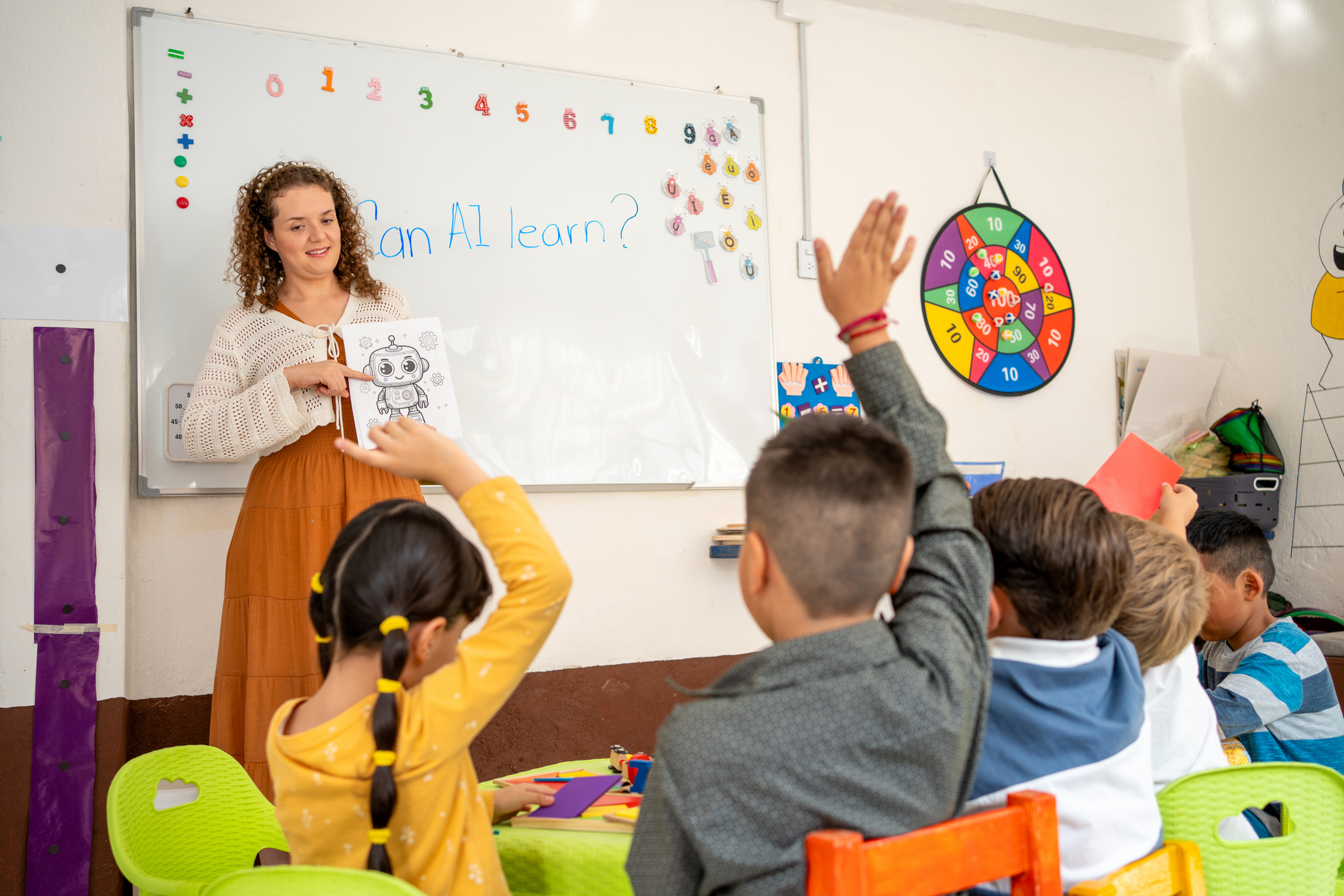
By August 2026, 37 states had adopted artificial intelligence (AI) guidance for public schools. But the “K” in this K-12 guidance rarely touches on kindergarten, and pre-K is left out altogether.[1] State guidance to date focuses largely on academic integrity, student plagiarism, and access to technology tools, which are not the typical concerns for younger children.
Yet most children have already spent years with AI by the time they enter kindergarten. It has been woven into daily life: through voice assistants that answer their questions, algorithms that queue their next video, stuffed animals that talk back to them. Designed to act like friends, these toys remember conversations and use children’s names, blurring the line between machine and person for children who are still learning about human friendship and potentially causing confusion and developmental harm.[2]
Most children have already spent years with AI by the time they enter kindergarten.
Children from birth to age 8 average roughly two and a half hours of screen time a day, according to a 2025 survey by Common Sense Media. The average climbs to nearly three and a half hours for ages 5 to 8. Forty percent of children have their own tablet by age 2. About six in ten parents of children ages 2 to 8 say their child talks to a voice assistant such as Siri or Alexa, and half say it happens at least once a day.[3]
Early Educators and AI Use
Early educators feel the gap in state guidance. In a RAND survey of 1,586 public school pre-K teachers, only 29 percent reported using generative AI during the 2024–25 school year, compared with 53 percent of K-12 teachers. Yet more than 80 percent of the same teachers agreed that ed tech could help with instructional planning, family communication, and documenting children’s learning.[4]
The ECE workforce arguably stands to gain the most from AI tools. Teaching young children runs on paperwork: daily observation notes, developmental checklists, portfolios, screening records, licensing files, and a constant stream of family updates, all squeezed into hours that could be spent with children. AI handles this sort of work well.
The ECE workforce arguably stands to gain the most from AI tools.
What holds teachers back is uncertainty about developmental appropriateness, and they are largely on their own with it: Just 37 percent had received training on how technology use in preschool settings should account for developmental needs.[5]
Screen Time and AI Literacy
While AI guidance for early childhood education is lacking, adding restrictions on screen time has occupied state legislatures. Sixteen of them considered bills in 2026 to restrict educational technology in classrooms; six enacted laws.[6] Alabama’s HB 78 and Utah’s HB 273 were the first, with Alabama’s bill extending to pre-K and child care settings.[7] In April, the Los Angeles Unified school board limited screen time across all grades, with a focus on eliminating it for elementary students.[8]
Much of the concern animating policymakers aligns with the findings of child development research.[9] But treating all classroom technology as equally harmful—and screen limits as the remedy—sidesteps real problems: replacement of adult judgment, human interaction, and sound teaching. Screen limits do not address the risks associated with AI toys, voice assistants, and algorithms that children encounter everywhere else.
Treating all classroom technology as equally harmful … sidesteps real problems.
There are age-appropriate solutions. Sorting games can help young learners distinguish human from computer decisions, for example. Stories about how tools are built can introduce AI in an accessible, unplugged way.[10] Even in states that ban screen use, leaders can set guidance around teaching young children what AI is. And underscoring the need to infuse early childhood classrooms with strong peer and adult interaction is more critical than ever.
Even in states that ban screen use, leaders can set guidance around teaching young children what AI is.
A Few States Lead the Way
Only a handful of states differentiate AI guidance by age. Washington names the core problem: Young children struggle to grasp that AI is not sentient because tools talk like people. Their guidance points elementary teachers to a middle path: guided activities where the teacher runs the tool and students explore how it works. New Mexico directs that AI literacy in grades K-5 center on explanations, discussions, simulations, and modeling, both online and unplugged, of foundational concepts, with more complexity in middle school. California covers transitional kindergarten through grade 12 and sets out AI literacy learning goals, sample activities, and prompts by grade span.[11] But states’ guidance is nearly blank for children from birth to age 5.
Recommendations for State Boards
Many state boards of education develop technology policy for the early grades, and they can extend their policies to encompass young learners in the following ways:
Adopt an AI literacy framework with age bands that start before kindergarten. A workable structure has three tiers: birth through pre-K, where the emphasis falls on protection, family awareness, and limits on child-facing AI; grades K-2, where instruction should rely on unplugged, educator-guided concepts; and grade 3 and up, where carefully supervised hands-on use can begin. North Carolina’s recommendations cover PK-13 public schools, with literacy suggestions organized by grade span and a dedicated elementary section. The K-2 section of North Dakota’s framework tells educators that children this age “need to understand that AI is not a real person” and that teachers should avoid language that humanizes AI tools. Its grade 3-5 section warns that overreliance on AI can short-circuit problem solving.[12] Anchoring a framework in existing early learning standards keeps it from becoming a free-floating document.
Anchoring a framework in existing early learning standards keeps it from becoming a free-floating document.
Invest in professional development. Pre-K teachers sit at the edge of district systems built for training K-12 staff, so they navigate fragmented support systems, and many of their peers in community-based and home-based settings fall outside those systems entirely. They are also among the lowest-paid educators, with little paid time for training of any kind. Some states invest in their ed tech skills. Maryland’s Artificial Intelligence Ready Schools Act provides compensated professional development through a train-the-trainer model. Alabama’s HB 78 pairs its new screen-time standards for early childhood with required training for teachers and staff. Under Tennessee’s Public Chapter 1056, teachers in grade 6-12 must complete a free, asynchronous professional development course on using AI in the classroom that the state education agency is to provide. Under state board licensure policies and rules, school districts must award professional development points to teachers for completing this training. While the 2026 law does not address teachers in earlier grades, it highlights the opportunity before the department, state board, and early childhood partners to consider comparable, developmentally appropriate professional learning for teachers of younger children.
Prepare new teachers to make informed decisions. Teachers should be equipped with skills and pedagogical approaches appropriate for young learners. Their education preparation programs can give teachers creative, play-based learning strategies for introducing concepts of ethics, equity, and technological responsibility to young learners.[13] State board members can stipulate that teacher education be grounded in early childhood standards and require evidence that AI literacy training meets these standards in holistic, developmentally appropriate ways.
Teachers should be equipped with skills and pedagogical approaches appropriate for young learners.
Engage families. Parents of young children tend to be easier to reach, more motivated to engage, and amenable to changing household technology habits. They are also largely in the dark. To help them, Oklahoma’s state education agency published a guide for K-2 parents on safe, supported technology use.[14] Teachers are the most likely to be engaging regularly with parents, but a teacher who has never been trained to evaluate a tool cannot explain it to a parent, much less field a question about what data it collects or whether a talking app is appropriate at home.
Distinguish screen time from AI. Limiting one does not mean banning the other. Screen time is about exposure—minutes, ages, content. AI literacy is about understanding how technology works and how to use it as a tool. A board can cap the first and still deliver the second. Utah’s HB 273, for instance, prohibits nearly all screen time in grades K-3. But the same law directs the state board to build AI standards into the computer science standards and publish a model AI use policy for every district to adapt, with districts certifying both to receive state ed tech funding.
AI literacy is about understanding how technology works and how to use it as a tool.
Conclusion
A review of many states’ guidance on ed tech and AI in the classroom reveals that the youngest learners are largely an afterthought.[15] State boards have an opportunity to center the needs of young learners in revised guidance: It ought to spell out what children should learn—and be protected from—at each age, beginning early. And early educators should receive the same training as their K-12 peers so they can be equipped to help young children and their families navigate the current era.
Winona Hao directs NASBE’s program work in early childhood education and in education technology. Janice Mak is a researcher and faculty member at Arizona State University and former Arizona State Board of Education member. She serves on the Association for Computing Machinery’s Education Advisory Committee and co-chairs their Ethical and Societal Impacts of GenAI in Education task force.
Notes
[1] Winona Hao, “States Take Next Steps on Governing AI Use in Schools,” Policy Brief 33, no. 2 (Alexandria, VA: NASBE, 2026).
[2] Robert W. Grundmeier et al., “Generative Artificial Intelligence: Implications for Families and Pediatricians,” Pediatrics 157, no. 4 (April 2026), https://doi.org/10.1542/peds.2025-074912.
[3] Common Sense Media, “Media Use by Kids Zero to Eight,” survey report (2025).
[4] Jordy Berne, Christopher Joseph Doss, and Anna Shapiro, “Pre-K Teachers Are Optimistic About Educational Technology, though Current Use Varies Widely: Findings from the American Public School Pre-K Teacher Survey,” research (RAND Corporation, 2025).
[5] Berne, Doss, and Shapiro, “Pre-K Teachers Are Optimistic.”
[6] Hillary Rinaldi et al., “Screen Time Legislation Is Moving Fast. Here’s What’s Actually Enacted,” Whiteboard Advisors, May 15, 2026.
[7] Abbie Telgenhof, “Elementary School Screen Time Limits Gain Momentum in 2026, “ Multistate blog, April 8, 2026.
[8] Sequoia Carrillo, “Several States—and the LA Public Schools—Are Setting Limits on Screen Time,” NPR, May 1, 2026.
[9] Samantha Teague, “Digital Media Use and Child Health and Development: A Systematic Review and Meta-Analysis,” JAMA Pediatrics 180, no. 5 (May 2026), DOI: 10.1001/jamapediatrics.2026.0085.
[10] Weipang Yang, “Artificial Intelligence Education for Young Children: Why, What, and How in Curriculum Design and Implementation,” Computers and Education: Artificial Intelligence 3 (2022), https://doi.org/10.1016/j.caeai.2022.100061.
[11] New Mexico Public Education Department, “New Mexico AI Guidance for K-12 Education” (2025); Washington Office of Superintendent of Public Instruction, “Human-Centered AI Guidance for K-12 Public Schools” (2024); California Department of Education, “Learning With AI, Learning About AI,” guidance (2025).
[12] North Carolina Department of Public Instruction, “North Carolina Generative AI Implementation Recommendations and Considerations for PK-13 Public Schools” (2024); North Dakota Department of Public Instruction, “North Dakota K-12 AI Guidance Framework.”
[13] Janice Mak, Wen Wen, and Marissa Castellana, “Examining Artificial Intelligence Curricula for Ethical Principles—A Bridge to Human Flourishing,” In Stamatios Papadakis, ed., AI Applications in Preschool and Primary Education (Springer, 2026).
[14] Oklahoma State Department of Education, “Artificial Intelligence for Families: Grades K-2,” guidance.
[15] Jennifer J. Chen and Victoria Delaney, “Leveraging AI to Enhance Children’s Learning: Anchoring Policy and Practice in Equity, AI Literacy, and Ethics for Education Leaders and Teachers,” Early Childhood Education Journal 54 (2025), https://doi.org/10.1007/s10643-025-02036-0.
 i
i
 i
i
 i
i