
New Faces, Shifting Parties Mark 2026 Midterm Elections for Education Officials
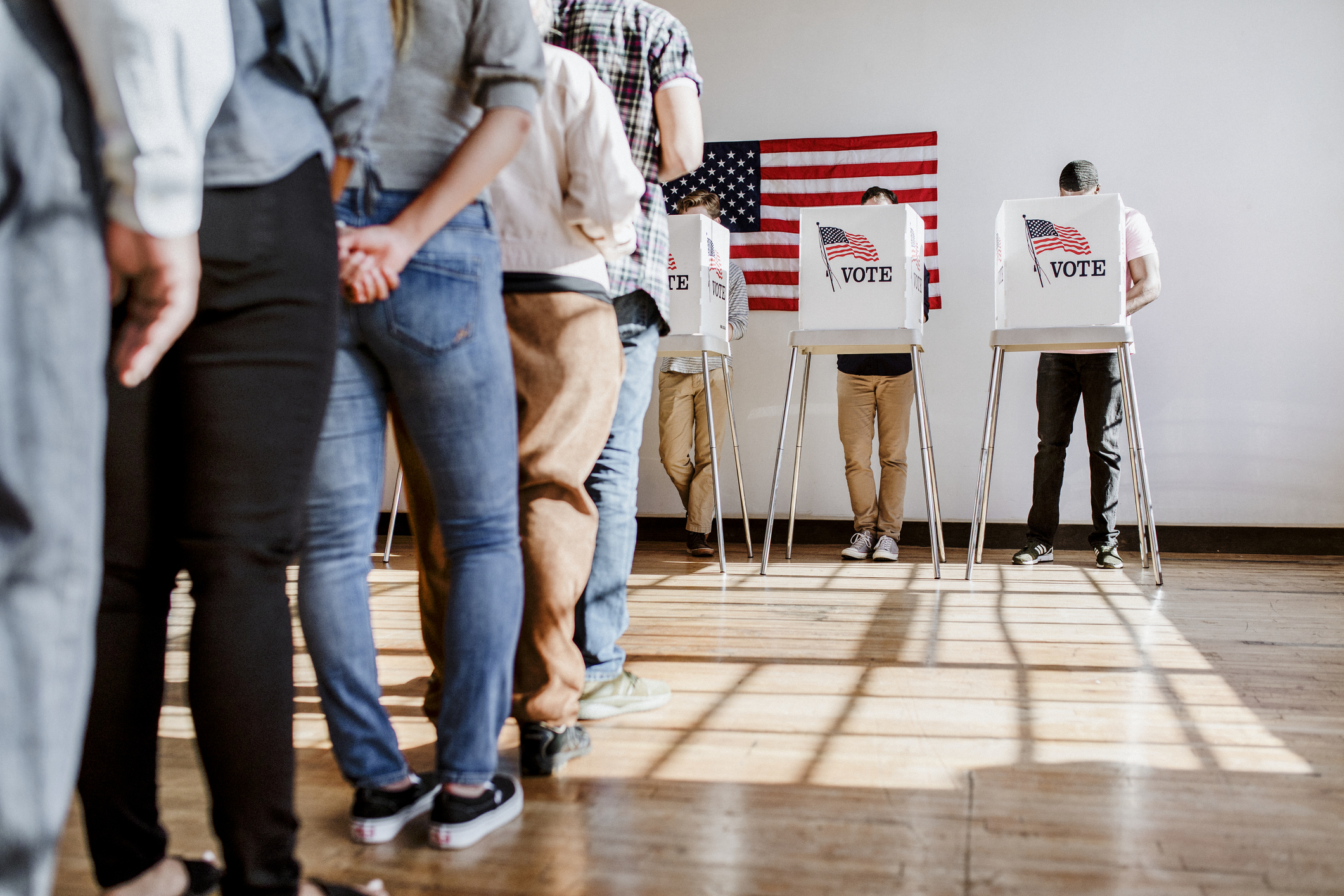
Just as the anticipated “blue wave” swept elections to federal offices in 2026, Democrats prevailed in several state races that will affect education policymaking: Voters flipped six states from Republican to Democrat in 40 gubernatorial elections. And among the 49 state board of education races across 13 boards, voters picked 27 newcomers. Eight of these seats shifted to blue, as did two of the eight chief state school officer races.
Lagging student achievement particularly in literacy, education funding, transgender athletes, and school choice animated election campaigns that were full of new faces. Incumbents did not run for about half of the elected state board seats. Three withdrew or lost their primaries; the rest were termed out or chose not to run. In states where the governor appoints the state board and Democratic candidates replaced Republicans—Alaska, Georgia, Iowa, Nevada, and Ohio—further board turnover is likely in the new year.
New governance models also herald shifts in board makeup. California’s Assembly Bill 181 swapped control of the state education agency from the elected state superintendent to the state board and assigned executive and administrative functions to a new governor-appointed education commissioner. The bill also added three seats to the state board, including one reserved for the state superintendent.
New governance models also herald shifts in board makeup.
In 2025, Ohio passed legislation reducing the number of state board members from 19—11 elected and 8 appointed—to 5, all appointed by the governor. This year, House Bill 455 added two more governor-appointed seats.
Elected Governors
Thirty-six states and three territories elected governors this cycle, and the District of Columbia elected a new mayor (see map). Fifteen incumbents retained their seats, while 24 candidates will take office for the first time.[1] Alaska, Georgia, Iowa, Nevada, Ohio, and Texas flipped from Republican to Democratic control; only Guam replaced its Democrat governor with a Republican.
Twenty-Four States Elect New Governors
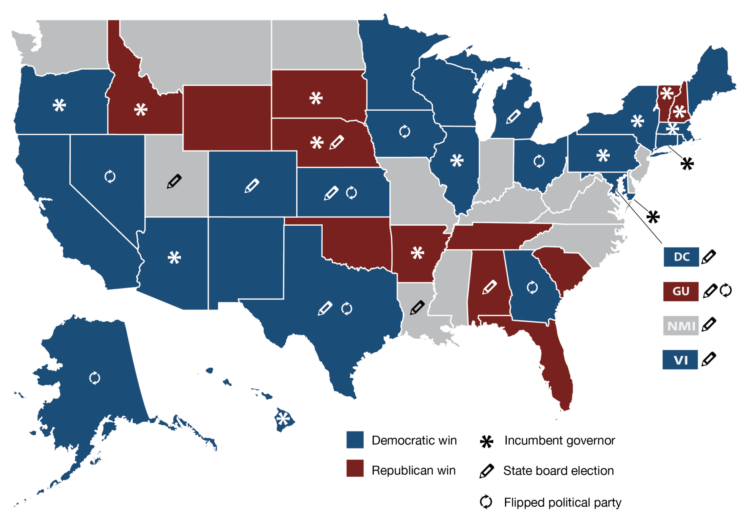
Seven states retained Republican control but with a new governor, yet narrow victories in Alabama, Florida, South Carolina, and Tennessee presage more competitive political environments. Many newly elected Republicans emphasized expanded school choice and parental involvement, literacy, and career opportunities during their campaigns.
Many newly elected Republicans emphasized expanded school choice and parental involvement, literacy, and career opportunities.
Florida’s Governor-Elect Byron Donalds promoted early literacy, debt-free career pathways, and personalized student success plans. Tennessee’s Marsha Blackburn, who previously introduced the Kids Online Safety Act during her time as senator, called for a bell-to-bell cell phone ban and expansions to the state’s Education Freedom Scholarship program.
In Ohio, pediatrician Amy Acton campaigned around increased public school funding and reforming the state’s private-school vouchers, which cost the state over $1 billion in fiscal 2025.[2] Iowa’s Rob Sand also highlighted vouchers, proposing reforms to Iowa’s Education Savings Account that would require annual audits, limit tuition increases, and set income limits. As state auditor, Sand interrogated the program’s $330 million price tag.[3]
In 2025, Texas lawmakers passed legislation and funding to create the state’s Education Freedom Accounts program, which Democratic Governor-Elect Gina Hinojosa called a “voucher scam” on her campaign website. A former Austin school board president, Hinojosa also targeted state takeovers of locally elected school districts and pledged to rethink high-stakes student testing and the A-F accountability system.[4] She tapped former state representative Ernest Bailes, a Republican who lost reelection after opposing Governor Greg Abbott’s school voucher push in 2023, to co-chair her transition team.[5]
In his campaign, Alaska’s Jonathan Kreiss-Tomkins supported “forward funding” public education, meaning the legislature should pass education funding earlier in the year to avoid budgeting uncertainties for schools and districts. He also highlighted cell phone bans in classrooms and teacher pay as key issues.[6]
Governor-Elect Keisha Lance Bottoms outlined plans to guarantee pre-K for every four-year-old, and she focused on literacy and early learning, financial literacy, eliminating the state income tax for teachers, and creating pathways to free technical and community college.[7] Nevada’s Aaron Ford—a former math teacher, state senator, and attorney general—emphasized increased school funding as well as expanded access to pre-K, improved literacy, and career and technical education.
Elected Chief State School Officers
Eight states elected chief state school officers, Idaho’s Debbie Critchfield, South Carolina’s Ellen Weaver, and North Dakota’s Levi Bachmeier ran and won as incumbents. Overall, partisan results mirrored the gubernatorial elections: Idaho, South Carolina, and Wyoming maintained Republican control. Newcomer Teresa Leyba Ruiz flipped Arizona’s seat blue, and Lydia Powell unseated three-time incumbent Richard Woods in Georgia. In California, where the elected state superintendent now sits on the state board, former school board president Richard Barrera won the election.
Overall, partisan results mirrored the gubernatorial elections.
Twenty-three state boards appoint their chief, eight of which—including Guam and the Northern Mariana Islands—held midterm elections for new board members this year. Newly elected governors in Texas, Iowa, Ohio, Nevada, and Alaska also have direct appointing authority and may opt for new faces in the coming years. Texas’s Hinojosa has already pledged to replace Commissioner Mike Morath with an educator.[8]
Elected State Boards
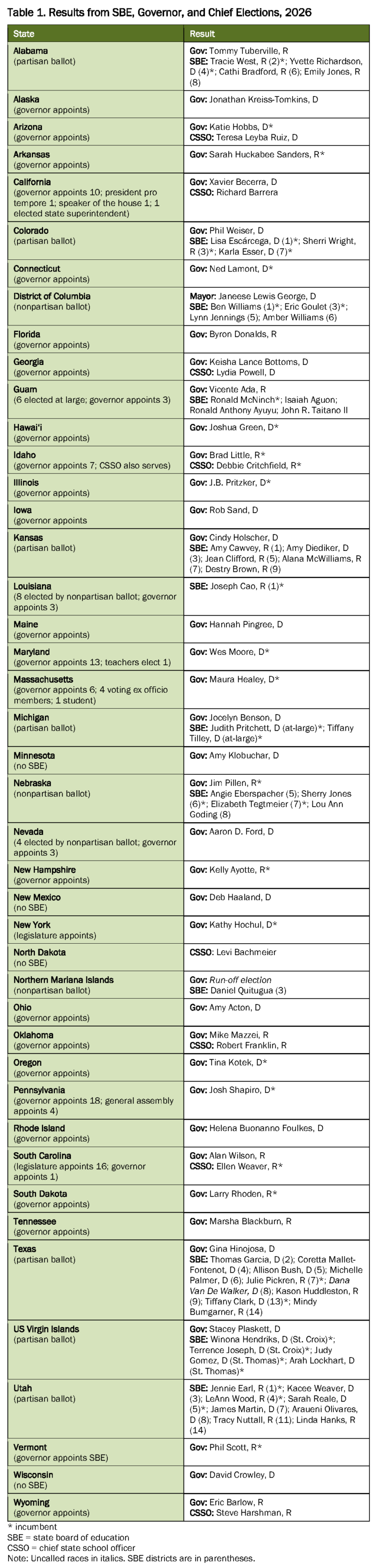
Voters in nine states, three territories, and Washington, DC, decided 49 state board races (see table). Nine seats flipped political party: four in Texas, three in Utah, one in Kansas, and one in Nebraska. Democrats gained an 8-7 lead on the Texas board, while Nebraska’s flipped seat—the only one that went from blue to red—gave Republicans a slim majority in a previously tied though officially nonpartisan board.
Voters in nine states, three territories, and Washington, DC, decided 49 state board races.
A background in teaching emerged as a voter priority. Thirty-one winning candidates have taught; nine—including four in Texas and two in Utah—replaced noneducators.
Incumbent state board members Tracie West and Yvette Richardson won their respective districts in Alabama, while newcomer Republicans Cathi Bradford, a longtime educator, and Emily Jones, a Moms for Liberty chapter chair, claimed open seats in Districts 6 and 8. No seats flipped political party, though Bradford unseated incumbent Marie Manning in the Republican primary.
Colorado state board members Lisa Escárcega, Karla Esser, and Sherri Wright kept their seats. Colorado voters also decided on two measures related to tax use and K-12 spending. Democrats Escárcega and Esser supported more equitable funding, while Wright, a Republican, opposed the tax changes, suggesting there was no guarantee additional funding would go toward education.[9]
In Kansas, all five incumbents chose not to run, including board member Michelle Dombrosky, who joined as a lieutenant governor on Republican candidate Charlotte O’Hara’s ultimately unsuccessful gubernatorial ticket. Yet voters still saw a familiar face. Jean Clifford, who lost her seat in the 2022 Republican primaries, won back District 5. Democrat Amy Diediker flipped District 3, slimming the Republican majority from 7-3 to 6-4, while newcomers Amy Cawvey, Alana McWilliams, and Destry Brown claimed the remaining open seats. Most winners highlighted their experience in education, including former elementary teacher Diediker, who suggested people were ready for a “champion for public education.”[10]
In Louisiana’s special election, Republican incumbent Joseph Cao defeated Angela Hershey for District 1. Cao, a former US congressman, was appointed to fill the seat vacated by Paul Hollis earlier in 2026.
Democrat incumbents Judith Pritchett and Tiffany Tilley defeated Republican challengers Terence Collins and Bree Moeggenberg for the at-large seats on the Michigan state board. Candidates on both sides advocated for a stronger focus on literacy and special education. Yet Republican hopefuls criticized the health education standards that were adopted in 2025 for recommending schools provide instruction on gender identity and sexual orientation.[11]
Of the four open seats in Nebraska, three already were Republican held, and newcomer Lou Ann Goding clinched victory in District 8, giving conservatives a 5-3 majority. Only board chair Elizabeth Tegtmeier and Sherry Jones ran as incumbents. Challengers focused on improving math and reading, student mental health, and educator preparedness, while largely shying away from hot-button issues that heated other races.[12]
According to unofficial results, the Texas state board saw four seats flip, giving Democrats—who previously held only four of fifteen seats—an 8-7 majority. Eight seats were up for election in November plus a special election in District 4 to replace Democratic board member Staci Childs, who resigned in August 2026 to run for the Texas House of Representatives. Republican Tammie Nielsen, who was appointed to replace Childs, lost to Democrat Coretta Mallet-Fontenot, a former educator.
Four incumbents—Rebecca Bell-Metereau, Will Hickman, Keven Ellis, and Evelyn Brooks—did not run. Brooks attempted a run for governor but was defeated during the Republican primaries. District 2’s LJ Francis lost to Victoria Hinojosa in the Republican primary after Hinojosa received an endorsement from Gov. Greg Abbott.[13] However, Democrat Thomas Garcia won Francis’s district. Julie Pickren and Tiffany Clark reclaimed their seats. At the time of publication, incumbent Audrey Young trailed Democrat Dana Van De Walker by fewer than 600 votes.[14]
Of eight seats on the ballot in Utah, five newcomers won, three of whom flipped Republican-held districts, giving Democrats five seats on the fifteen-member board. Republicans Christina Boggess, Cindy Davis, and Emily Green did not file for reelection, and Joseph Kerry vacated his seat in September. Democrat Kacee Weaver won his district as its only candidate, though Governor Spencer Cox has since nominated Republican Katrina Gibson to fill the vacancy until Weaver’s term begins in January.
Democrat newcomer James Martin defeated Republican Erin Longacre, who had been representing District 7 since August 2025, when she was appointed to replace board member Molly Hart, who became the superintendent of public instruction. On the Republican side, voters reelected Jennie Earl, LeAnn Wood, and Sarah Reale and added newcomers Tracy Nuttall and Linda Hanks to the board.
Voters in Washington, DC, reelected Ben Williams to Ward 1 and narrowly returned Ward 3’s Eric Goulet to the board. Newcomers Lynn Jennings and Amber A. Williams won their nonpartisan bids for Wards 5 and 6, which were left open by Robert Henderson and Brandon Best.
Guamanians reelected Ronald McNinch and added newcomers Isaiah Aguon, Ronald Anthony Ayuyu, and John R. Taitano II to the board’s four at-large seats. The Northern Mariana Islands welcomed Daniel Quitugua, who ran unopposed, to the board’s District 3. Democrat incumbents Winona Hendriks, Terrance Joseph, Judy Gomez, and Arah Lockhart kept their spots on the US Virgin Islands board.
Ballot Measures
Voters also weighed in on school funding measures. In California, voters made permanent a tax increase for the top 2 percent of income earners that would fund education and health care. Through Proposition NN and Amendment 87, Coloradoans voted to increase the constitutional limit on the amount of revenue the state can spend, replace the uniform tax rate requirement with a graduated income tax, and direct additional revenue to K-12 expenses. New Hampshire voters rejected a cap for local school district taxes, and Arizonans voted against requiring large school districts to spend at least 60 percent of their budget on direct instructional expenses.
Voters also weighed in on school funding measures.
Voters in Arizona, Colorado, Nebraska, and Washington approved restrictions on transgender student athletes from competing in girls’ sports. North Dakotans defeated a constitutional amendment that would have guaranteed free school meals for all K-12 students.
Joey Hedger is program manager and editor at NASBE. Naomi Porter is a project associate.
Notes
[1] The Northern Mariana Islands will hold a run-off election for its governor race, since neither candidate received enough votes to win.
[2] Megan Henry, “Ohio Spent More than a Billion Dollars on Private School Vouchers in Fiscal Year 2025,” Ohio Capital Journal, October 20, 2025; Ohio Department of Education and the Workforce, “Scholarship Payments,” web page.
[3] Rob Sand, “ESA Policy Impact Report,” web page (Des Moines, Iowa: Office of Auditor of State, June 17, 2026).
[4] Gina Hinojosa for Texas Governor, “Save Texas Public Schools,” campaign web page.
[5] Blaise Gainey, “Hinojosa Taps Anti-School Voucher Republican, Education, and Labor Allies for Texas Transition Team,” Houston Public Media, November 5, 2026.
[6] Sydney Dauphinais, “Jonathan Kreiss-Tomkins Talks Education Funding, Fisheries, and Reviving the Ferry System,” KRBD, May 18, 2026; JKT for Alaska, “What JKT Standards For,” campaign web page.
[7] Keisha for Governor, “Issues,” campaign web page.
[8] Megan Menchaca, “State-Appointed Managers in Texas Takeover School Districts Brace for Imminent Removal,” Texas Tribune, November 6, 2026.
[9] Jinny Kim, “Colorado State Board of Education Race Results,” Colorado Public Radio, November 3, 2026.
[10] Baya Burgess, “Democrat Flips State Education Board Seat but GOP Maintains Majority Control,” Kansas Reflector, November 4, 2026.
[11] Isabel Lohman, “Who Are the Michigan State Board of Education Candidates? What to Know,” Bridge Michigan, September 23, 2026.
[12] Hannah Nazarenus, “State Board of Education Voter Guide: Meet the Candidates Running,” Nebraska Public Media, October 7, 2026.
[13] Meredith Dyer, “Here Are the Primary Results for the Texas State Board of Education Races,” Texan, March 9, 2026.
[14] Young can call for a recount.
 i
 i
 i