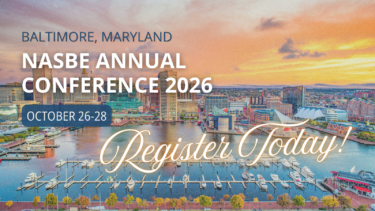
The only organization dedicated solely to helping state boards advance equity and excellence in public education.


NASBE members are organized into four regions: Northeast, Southern, Central, and Western. Members from each region are represented on our board of directors.


Northeast:

Connecticut, Delaware, District of Columbia, Maine, Massachusetts, New Hampshire, New Jersey, New York, Pennsylvania, Puerto Rico, Rhode Island, Vermont, Virgin Islands

NASBE Regional Liaisons: Winona Hao and Joseph Hedger


Southern:

Alabama, Arkansas, Florida, Georgia, Kentucky, Louisiana, Maryland, Mississippi, North Carolina, South Carolina, Tennessee, Texas, Virginia, West Virginia

NASBE Regional Liaison: Renee Lang


Central:

Illinois, Indiana, Iowa, Kansas, Michigan, Minnesota, Missouri, Nebraska, North Dakota, Ohio, Oklahoma, South Dakota, Wisconsin

NASBE Regional Liaison: Valerie Norville


Western:

Alaska, American Samoa, Arizona, California, Colorado, Guam, Hawaii, Idaho, Montana, Nevada, New Mexico, Northern Marianas Islands, Oregon, Utah, Washington, Wyoming

NASBE Regional Liaison: Abigail Potts.


Featured Items

Complexity of thought processes and the human mind. Thoughts, creativity, emotions, mental health, vibrant art collage. Psychology, self-analysis, mental disorders and wellbeing, cognitive processes i

States Take Next Steps on Governing AI Use in Schools

In 2026, state boards of education are likely to move beyond issuing AI guidance and toward monitoring implementation and possibly developing policies.
Happy African American teacher and elementary student talking while walking through hallway. i

States Start Up Registered Principal Apprenticeships

A handful of states have been launching federally registered apprenticeships to better prepare new principals, remove barriers to entering the profession, and combat turnover.
A young university student female is practicing her welding skills i

Demonstrating Skills of Value

State education leaders are focused on ensuring students graduate ready for life after high school—but how do students know they’re building valuable, transferable skills, and how will employers and colleges recognize them?

Upcoming Events

From the States