
A State Leader’s Guide to Strategic School Staffing
Redesigning teacher roles can solve several problems confronting schools at once.

Imagine a first-year teacher named Cara who has 28 students. Her district has adopted high-quality instructional materials (HQIM) that require deep preparation to use effectively, but her daily planning period is frequently consumed by grading, emails, or meetings instead of lesson prep. Cara has a mentor down the hall, but because their schedules rarely align, their check-ins are often rushed. She receives a formal observation twice yearly but lacks the consistent, just-in-time coaching needed to refine her craft. Although she enjoys her students, the responsibility for each child’s progress rests entirely on her shoulders, leaving her overwhelmed.
Now imagine a teacher named Marcus, who works in a neighboring district. Like Cara, he is a first-year teacher, but instead of working in isolation, he is on a team led by a veteran teacher leader who provides him with modeling and feedback to help him master his district’s HQIM. Because the school uses subject-matter specialization and a redesigned master schedule, Marcus also has dedicated, collaborative planning time to prepare for lessons alongside his colleagues. Within his classroom, he has multiple partners, including an English learner teacher and a tutor, who collaborate to meet each student’s academic and socioemotional needs. Marcus feels supported and effective in his current role, and he looks forward to growing into a leadership role.
Although Cara and Marcus are fictional, the experiences described are real, and the team environment Marcus enjoys is increasingly common thanks to the adoption of strategic school staffing models. These models, sometimes called innovative staffing, reimagine the teaching profession by disrupting the “one teacher, one classroom” model.[1]
As K-12 districts grapple with persistent learning gaps and acute teacher shortages, strategic staffing offers a powerful solution to both challenges. Because early adopters have demonstrated these models’ viability and effectiveness, state leaders have begun to scale them. Doing so involves start-up costs, including for technical assistance. While the long-term costs of any given model will vary by local context, districts ideally will be able to fund strategic staffing sustainably through a variety of potential funding streams.
As K-12 districts grapple with persistent learning gaps and acute teacher shortages, strategic staffing offers a powerful solution to both challenges.
Our organization, Education First, published a report on the US strategic staffing landscape in 2023.[2] In it, we defined strategic staffing and the problems it is intended to solve, models in use, and the evidence for their impact. We build on that work here with a focus on the state’s role in seeding and supporting effective strategic staffing initiatives.
Elements of Strategic Staffing
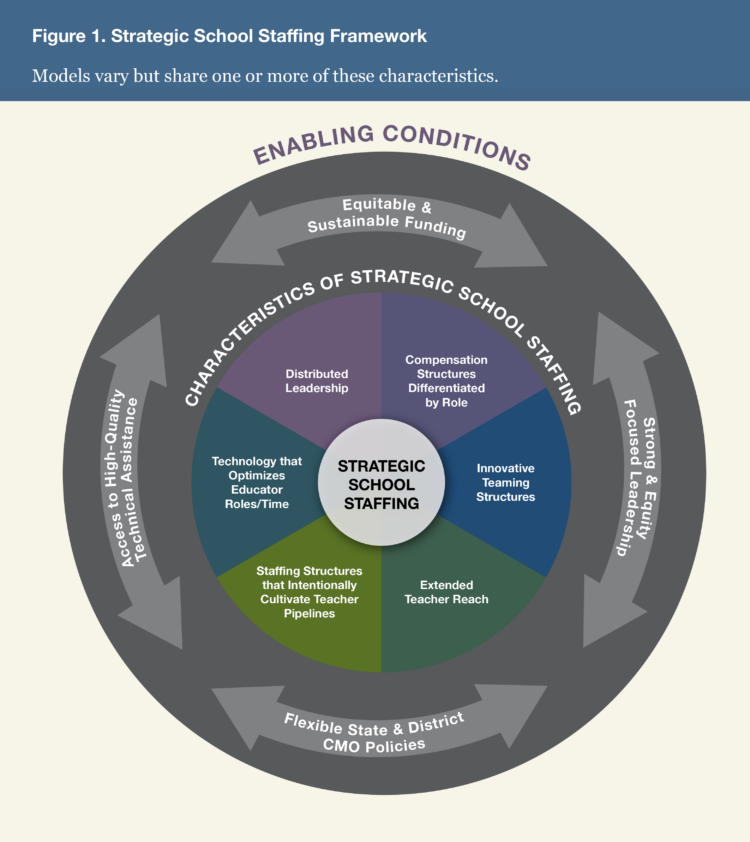
Strategic school staffing redesigns teachers’ roles in order to improve student learning outcomes while making the teaching profession more attractive and sustainable. Strategic staffing models vary by campus, but all share a focus on creating impactful, sustainable roles for educators by incorporating one or more of these characteristics (figure 1):
- Distributed Leadership. Responsibility for providing teachers with consistent feedback and coaching is distributed across a team of school and teacher leaders.
- Differentiated Compensation. Teachers who take on leadership roles are paid more.
- Innovative Structures. Effective, diverse teams of teachers with differentiated roles are collectively accountable for student success.
- Extended Teacher Reach. Exceptional educators impact more students by teaching larger classes or serving as teacher leaders.
- Structures That Cultivate Teacher Pipelines. Paid support roles—tutors or paraprofessionals, for example—are part of team structures that blaze clear pathways into teaching.
- Technology That Optimizes Educator Roles and Time. Technology reshapes the educator’s role, time allocation, or both—for example, through AI or technology-enabled outsourcing of courses.
Strategic staffing is more than a residency program, departmentalizing instruction by subject, or “flipping the classroom.” A strategic staffing model may incorporate these elements, but it represents a much bigger play to create a unified academic and talent strategy, ensuring that everything a school uses to recruit, prepare, deploy, and retain educators—from pipelines to staff assignments to scheduling to professional learning—supports its efforts to deliver an exceptional education to every student.
Moving away from “one teacher, one classroom” requires foundational shifts in a school’s culture and structures. For example, traditional staffing models center the principal as the sole instructional leader for the school; strategic staffing calls for a culture that values and develops instructional leadership in many forms and corresponding structural changes to create new leadership roles and compensate them. Under traditional staffing, a single teacher of record holds responsibility for the academic growth of a class of students; strategic staffing fosters a culture in which multiple adults share responsibility for student growth, supported by structures like updated teacher evaluation processes and student information systems. Changes this significant cannot happen without strong buy-in from school and district leaders, flexible policies, and access to high-quality technical assistance.
Moving away from “one teacher, one classroom” requires foundational shifts in a school’s culture and structures.
These models require sustainable funding, too. Although the ongoing cost of a strategic staffing model will vary widely depending on state and local context, key cost drivers will include technical assistance for the design and launch of the model; compensation for teacher leaders; and measurement and evaluation to assess the impact of the model on student learning, teacher quality, and teacher retention. Given this reality, it is important to understand why a school might invest time and resources into a strategic staffing model.
Why Strategic Staffing?
Student learning has been in decline since well before the pandemic, with disparities between high- and low-performing students widening significantly. As of 2024, only 22 percent of twelfth graders were proficient in math on the National Assessment of Educational Progress (NAEP), and just 35 percent were proficient in reading.[3] Adding to these disheartening results are data indicating low student engagement in school. About 30 percent of fourth and eighth graders report high absenteeism.[4] And 52 percent of third through twelfth graders disagree with this statement: “I feel part of the community at my school. There are a lot of people who know and care about me.”[5]
Meanwhile, warning indicators for the educator workforce are blinking red. The Learning Policy Institute estimates that about 1 in 8 of all teaching positions nationally is either vacant or filled by teachers not fully certified for their assignments, with attrition generating most of the gap.[6] Although educator morale and well-being are starting to trend upward, over half of teachers (53 percent) report feeling burned out,[7] and around 18 percent are considering leaving the profession, driven by dissatisfaction with their pay, working conditions, and stress levels.[8]
Although educator morale and well-being are starting to trend upward, over half of teachers (53 percent) report feeling burned out.
States and districts are fighting these trends on multiple fronts. On the academic side, they are implementing science of reading reforms, adopting HQIM, and investing in outreach and incentives to boost engagement and combat chronic absenteeism. On the talent side, they are reducing barriers to entry, funding teacher residency and apprenticeship programs, and exploring differentiated pay strategies.
These interventions may do some good, but each targets just a piece of the K-12 system, and the efficacy of each intervention is limited by the capacity and health of that system as a whole. Adopting HQIM does little good if teachers do not use them effectively. Effective use of HQIM does not help students if they are not in school. Students who attend class will not learn as much if they have an underprepared teacher.
In contrast, strategic staffing offers the opportunity to redesign an entire system to align resources around priorities. Districts can redeploy their strongest educators as coaches to support effective use of HQIM, surround students with teams of teachers so they form more relationships with caring adults at school, deliver high-touch clinical experiences to preservice educators to bolster the local teacher pipeline—or all of the above.
Strategic staffing offers the opportunity to redesign an entire system to align resources around priorities.
Evidence of Impact
How well have strategic staffing models lived up to their promise? Direct causal impacts have not been established, but research offers promising correlational evidence for a few of the models.
Student learning. An evaluation of a large Texas district using the Opportunity CultureⓇ model from 2021 to 2024 found significant positive academic gains for students taught by multiclassroom leaders, equivalent to an additional 6 to 13 months in reading and 6 to 9 months in math when compared with other district teachers.[9]
A 2024 evaluation for North Carolina schools using Advanced Teaching Roles™ (ATR) found significant gains in math test scores, with schools implementing the model for at least five years experiencing stronger gains.[10]
Teacher quality and retention. The 2024 ATR evaluation included preliminary findings that the academic growth of students taught by less-experienced teachers who received support from advanced teacher leaders was comparable to that of students taught by other teachers, suggesting that some strategic staffing models may strengthen novice teachers’ skills.[11]
A 2025 analysis of the Next Educator Workforce™ (NEW) model showed that teachers working within NEW teams were significantly less likely to leave their positions compared with those in traditional classrooms.[12]
State Examples
Hundreds of campuses across the US are using strategic staffing models, with hot spots where early adopters’ successes inspired nearby districts to follow suit. A technical assistance partner and often a local intermediary support these efforts. Clusters can be found in Arizona (home of NEW), Michigan (Michigan Educator Workforce Initiative), North Carolina (Public Impact and BEST NC), Tennessee (TN SCORE), and Texas (US PREP), among others.
Hundreds of campuses across the US are using strategic staffing models, with hot spots where early adopters’ successes inspired nearby districts to follow suit.
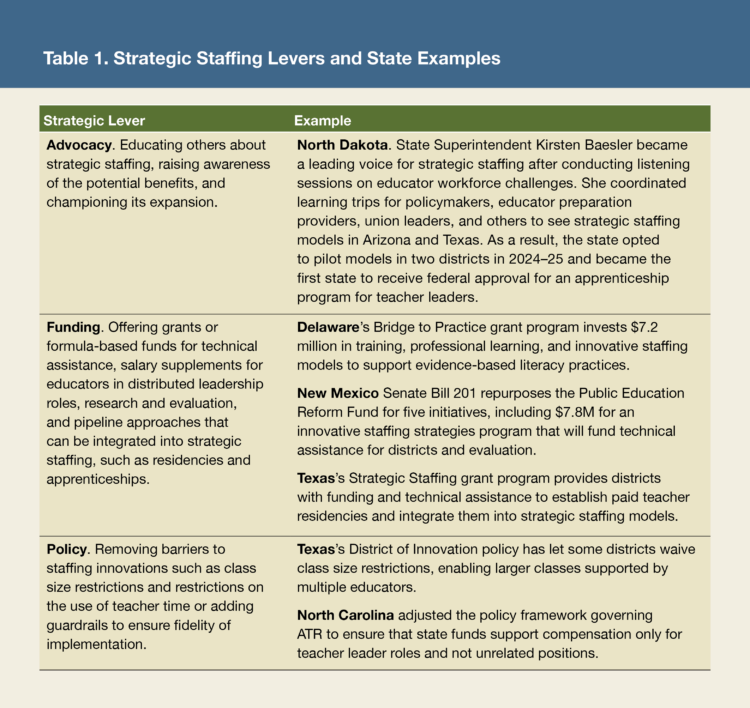
Against this backdrop, state leaders are building the enabling conditions for more schools to undertake a full staffing redesign by pulling one or more of the strategic levers available to them: advocacy, funding, and policy (table 1). Michigan and North Carolina offer two unique approaches.
Michigan. In 2024, four schools across three Michigan school systems pioneered team-based teaching models with support from Next Educator Workforce™ and the Michigan Educator Workforce Initiative (MEWI). Participating schools saw benefits immediately, with significantly higher academic growth from fall to winter in the second grade than in previous years and historically low ninth-grade failure rates. Additional grades in the first cohort of schools and eight more campuses joined the pilot in 2025–26, and at least 10 more schools spanning seven districts are expected to join in 2026–27.
As an intermediary, MEWI receives state funds to provide technical assistance, direct grants to piloting educators, and physical plant updates to facilitate effective teams. Bellwether and the University of Michigan will conduct an independent evaluation of this work.
Jack Elsey, MEWI’s founding partner and CEO, credits pilot school selection and the model’s adaptability for the success in Michigan schools. MEWI and NEW conducted a statewide outreach campaign through MEWI’s extensive partner network, reviewed applications, held screening calls, and conducted site visits.
“It’s not enough to find a superintendent who wants to try this,” Elsey said. “You need a full team of teachers who are ready to jump in.”
“It’s not enough to find a superintendent who wants to try this …. You need a full team of teachers who are ready to jump in.”
Surmounting policy and logistical hurdles requires the ongoing commitment of school teachers and leaders and partners who can adapt models to local contexts, Elsey said.
North Carolina. The ATR program, created by the state’s General Assembly in 2016, lets districts structure schools in ways that increase effective teachers’ impact and retention rates and support developing teachers. Based on early successes and strong demand, the pilot program was made permanent in 2020. Districts opt in via an annual request for proposals administered by the Department of Public Instruction.
By school year 2026–27, more than one-third of North Carolina districts will have opted into ATR, with several on the waiting list until more state technical assistance funds become available. The initiative’s leaders are aiming for 100 percent adoption within 10 years.
By school year 2026–27, more than one-third of North Carolina districts will have opted into ATR, with several on the waiting list.
Public Impact is the primary technical assistance partner, supporting districts in implementing Opportunity CultureⓇ models. A coalition of business leaders called BEST NC provides research, communications, stakeholder engagement, convening, and direct advocacy to support the initiative. Both organizations have been intentional about ensuring that the work belongs to the state and cannot be credited to any single organization or individual. “ATR is collective work, done by North Carolinians for North Carolina educators and students,” said Brenda Berg, president and CEO of BEST NC.
Because of a strong evidence base built over 10 years, ATR has earned support from governors, legislators, the state board of education, and the state superintendent and become embedded in the state’s education system.
“From the start, we aimed for districts to sustain their models by repurposing existing local funds,” Berg said. State funding has targeted start-up costs and gaps that districts cannot reasonably cover alone. Districts receive funding for technical assistance to design and launch their models, while the state covers a portion of supplemental pay for ATR roles and districts fund the remainder. This approach preserves district ownership, limits exposure to shifts in state appropriations, and ensures state funding is targeted where it is most needed.
The opt-in character of the initiative is also key to sustained commitment. “You have to trust the work, start with willing partners, and build over time,” Berg said.
What State Leaders Can Do
With the headwinds of tight budgets, tough politics, and stagnant student growth, it might be tempting to think the time is not right to attempt systemic reform. But we would argue that this is exactly the right time for teachers to leave the isolation of separate classrooms, rally around their students, and combine their strengths.
This is exactly the right time for teachers to leave the isolation of separate classrooms, rally around their students, and combine their strengths.
Hundreds of innovative school leaders across the country are embracing strategic staffing, with more poised to follow. State board members can lead the way by taking three steps:
Learn more. In addition to this issue of the State Education Standard, explore the recommended reading list below. Visit a campus that has adopted strategic staffing to see it in action. Ask its teachers, principals, district leaders, and—if applicable—labor partners what the process has been like and how it has affected student learning, teacher quality, and teacher well-being.
Fill needs. If there are systems in your state pursuing this innovation, help the work along by advocating for funding to design and implement strategic staffing models, identifying technical assistance partners, ensuring pilots are paired with research and evaluation of intended outcomes, and supporting the removal of policy barriers that prevent schools from adopting the staffing shifts they need to meet their strategic goals.
If there are systems in your state pursuing this innovation, help the work along by advocating for funding to design and implement strategic staffing models.
Connect the dots. Help ensure that local strategic staffing efforts are aligned with the state’s academic and teacher talent strategies. Make connections between organizations and leaders involved in these efforts. Encourage other policy leaders to support the work.
The staying power of a K-12 reform lies not in whether it is a good idea—it is in the extent to which the change becomes embedded in the school system. Strategic staffing, executed well over time, offers a durable solution for making good ideas stick because it gives educators the space and support to make effective practices their own.
States can now ensure strategic staffing models “stick” through the advocacy, funding, and policymaking that move schools away from the “one teacher, one classroom” model to a collaborative approach that better serves students and teachers alike.
John Luczak is a partner at Education First. For questions about this article, contact him at jluczak@education-first.com. Allison Pennington is director of business development at Education First. Sarah Begeman is a senior consultant.
Recommended Reading
Accounts of Strategic Staffing in Practice
BEST NC. “A Closer Look at Advanced Teaching RolesTM in North Carolina Video Series.” 2023.
National Council on Teacher Quality. “Reimagining the Teaching Role: District Spotlights.” September 2024.
Next Education Workforce. “School Spotlights.” 2024.
Research and Evidence for Strategic Staffing
BEST NC. “Advanced Teaching Roles™ in North Carolina: Meaningful Career Pathways for Education Professionals.” Policy Brief. 2022, updated 2025.
Education Resource Strategies. “Innovative Staffing, Strategic Resource Shifts, and the Road to Financial Sustainability: Evidence from Two Leading-Edge Districts.” Report. February 2025.
Ingersoll, Richard, Lennon Audrain, and Mary Laski. “Team-Based Staffing, Teacher Authority, and Teacher Turnover.” Report. Center on Reinventing Public Education, June 2025.
Kovacic Duran, Kelly, and Rashidah Lopez Morgan. “Strategic School Staffing Solutions.” Web page. Education First, 2022.
National Council on Teacher Quality. “Reimagining the Teaching Role: Research Summary.” September 2024.
Sarah Bausell et al. “Advanced Teaching Roles: Annual Evaluation Report.” NC State University College of Education and William & Ida Friday Institute for Educational Innovation, November 2024.
Policy Recommendations to Support Strategic Staffing
Education Resource Strategies. “The State Leader’s Role in Reimagining the Teaching Job.” Blog. May 22, 2024.
National Council on Teacher Quality. “Reimagine Teaching, National Landscape: State Leaders.” Web page.
Zamarripa, Sophie, David Casalaspi, and Titilayo Tinubu Ali. “Realizing Reimagined Teaching: A Framework for Strategic Staffing Implementation.” Bellwether, January 2026.
Notes
[1] This article offers a conceptual overview of strategic staffing. For more detail on what strategic staffing models look like in real schools, explore the resources on the recommended reading list at the conclusion of the article.
[2] Kelly Kovacic Duran, Jesse Friedman, and Rashidah Lopez Morgan, “Strategic School Staffing Solutions,” web page (Education First, 2023).
[3] National Center for Education Statistics, The Nation’s Report Card, “Explore 2024 NAEP Results for Science at Grade 8 and Mathematics and Reading at Grade 12,” web page, updated January 20, 2026.
[4] National Center for Education Statistics, The Nation’s Report Card, “Experience and Opportunities in Education: Days Absent from School (Grade 4),” web page.
[5] Rebecca Winthrop, Youssef Shoukry, and David Nitkin, “The Disengagement Gap: Why Student Engagement Isn’t What Parents Expect,” research (Brookings Institution, January 6, 2025).
[6] Learning Policy Institute, “An Overview of Teacher Shortages: 2025,” fact sheet (July 16, 2025).
[7] Elizabeth D. Steiner et al., “Teacher Well-Being, Pay, and Intentions to Leave in 2025: Findings from the State of the American Teacher Survey” (RAND, June 24, 2025).
[8] Gallup and Walton Family Foundation, “Teaching for Tomorrow: Educators on the Future of Their Profession,” survey report (2025).
[9] Jacob Kirksey et al., “Evaluating Opportunity Culture: Improving Student Achievement through Strategic Staffing in West Texas,” policy brief no. 5 (Texas Tech University College of Education, February 2026).
[10] Sarah Bausell et al., “Advanced Teaching Roles: Annual Evaluation Report” (NC State University College of Education and William & Ida Friday Institute for Educational Innovation, November 2024).
[11] Bausell et al., “Advanced Teaching Roles,” evaluation.
[12] Richard Ingersoll, Lennon Audrain, and Mary Laski, “Team-Based Staffing, Teacher Authority, and Teacher Turnover,” report (Center on Reinventing Public Education, June 2025).
Also In this Issue

A State Leader’s Guide to Strategic School Staffing
By John Luczak, Allison Pennington and Sarah BegemanRedesigning teacher roles can solve several problems confronting schools at once.

Half as Likely to Leave: What Team-Based Staffing Means for Teacher Retention
By R. Lennon Audrain and Richard IngersollBy treating retention as a challenge of system and organizational design, state boards can encourage more teachers to stay in the profession.

Achieving Results through School Redesign
By Sharon Kebschull Barrett and Bryan C. HasselFive principles guide staffing design, and state leaders have three tasks.

Supporting and Sustaining Paid Teacher Residencies
By Julie Fitz, Cathy Yun, Victoria Wang, Jennifer Bland, Wesley Wei and Steve WojcikiewiczCalifornia and Texas offer up lessons in how strategic staffing can help.

Bold Bets to Elevate School Leaders
By Megan Bennett and Chelsi ChangState boards can help revolutionize the principalship.

How State Policy Can Help Teachers Use AI Well
By Bree Dusseault, Shira Haderlein, Emily Prymula, Chelsea Waite, Melissa Fall, Michael Berardino and Dana HarrisonSmart guidance will give teachers the time, trust, and support to make technological leaps that advance learning.

 i
i