

The NASBE Interview: Byron Ernest
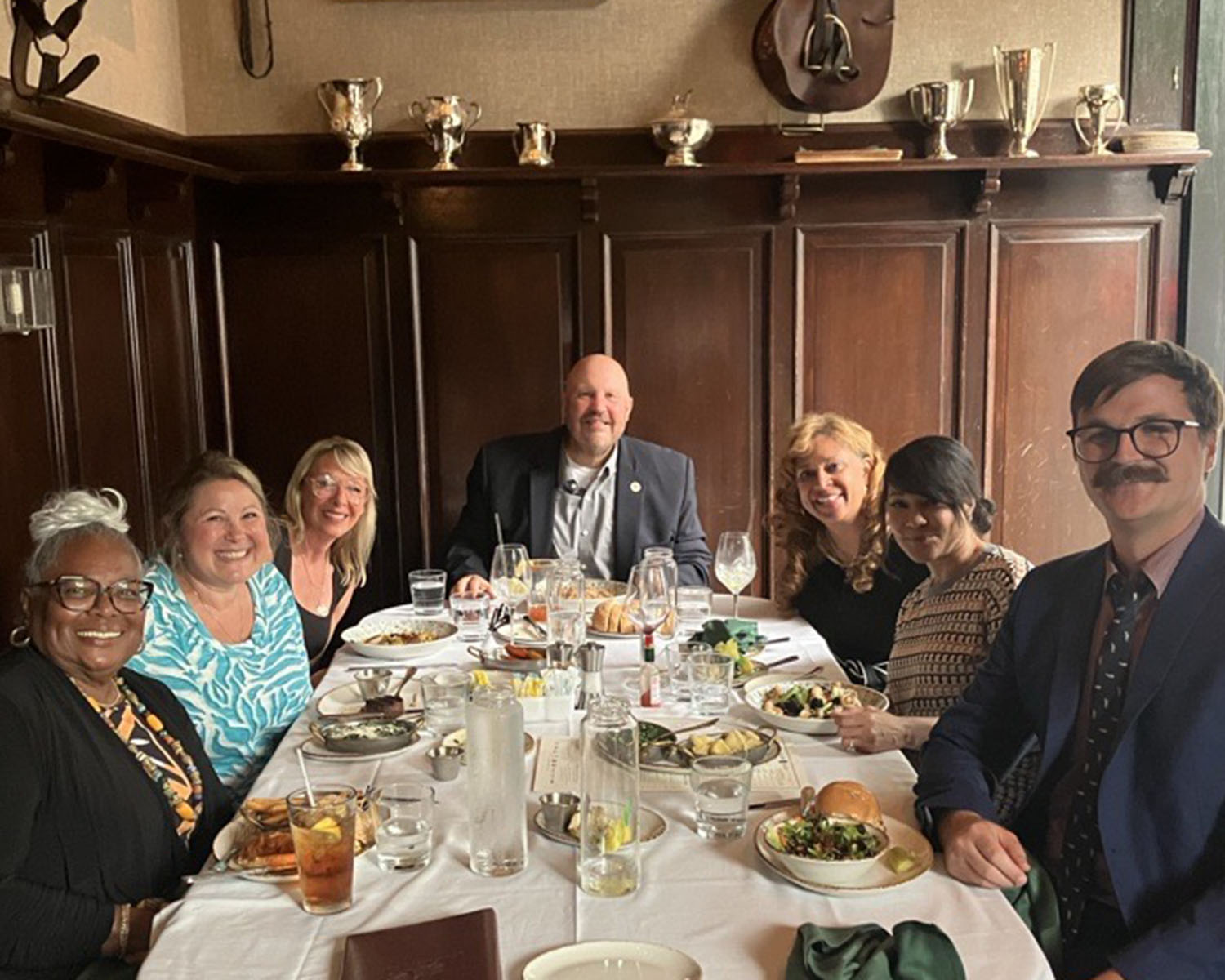
Byron Ernest has been a member of the Indiana State Board of Education since 2015 and chairs NASBE’s Board of Directors. NASBE Editorial Director Valerie Norville interviewed him in July 2026.
What stands out to you about your first year in the classroom? And as a leader of a school?
When I started, we did not have [learning] standards yet. I watched that come into being during my career, and that’s why I love standards so much. For several years, I was thinking, “Gosh, I know how to teach. But am I getting the right stuff taught?”
[My first year as a school leader] was a whole other ballgame. I didn’t know what I didn’t know. In some cases, I didn’t know what I did know. Being okay with that led to a lot of my success as a first-year principal. You have to remember, I was taking over the state’s worst-performing school: Emmerich Manual High School. Having a mindset of being okay with people knowing I don’t know things really helped because I was very open to any support I was given. I believe being vulnerable is a leadership attribute that is underused.
Having a mindset of being okay with people knowing I don’t know things really helped because I was very open to any support I was given.
My mantra at that time was, “Make it so.” I loved that Captain Picard on Star Trek used to say that. [I’d tell staff,] “You all are incredibly talented and have the expertise. I want to know what you want to do. And then let’s do it. I’ll help support you with that.”
What were the chief academic and school culture challenges at Emmerich Manual High School? How did you set priorities?
According to the state, Emmerich Manual had failed for eight consecutive years. Our state superintendent of public instruction at the time, Tony Bennett, decided to exercise the state’s legal right to take over five schools in 2010.
We had a year to evaluate the school and decide what staff we were going to keep. By state law, we couldn’t keep more than 50 percent of the staff. We kept four. When we looked at the school to get a feel for what was going on, I couldn’t tell what was passing period and what was class time. It was chaos.
They didn’t have robust athletics. I kept saying, “We’re not only going to turn this school around; we’re going to make it a real school.” We brought back the football team, for example. Then I’m like, “We’re going to have a homecoming and a pep session.” I had students asking me, “What the heck is a pep session?” The culture piece just was not there. The kids did not feel a part of the school. Students were just coming to school because they had to.
I kept saying, “We’re not only going to turn this school around; we’re going to make it a real school.”
On one side of the school, students were dropped off or were walking in, and on the other side were buses. I would alternate days and be out there to shake hands and welcome them. The first few days were rough. There were students who didn’t want to be there, didn’t want to talk to me, would not make eye contact. Of course, it became the challenge: “By gosh, I’m going to make you talk to me. I’m going to make you like me before it’s all over.” It got to the point where if I wasn’t out there, students were seeking me out: “Hey, why weren’t you out there this morning?” or “I need my handshake.”
I kept saying, “How did this school get to a point where it failed eight years in a row?” To me, a large portion of that was culture. When I first started, I had all kinds of advice. People would say, “First, you’ve got to turn the culture around, then you work on the academics.” Others [would say], “You need to work on academics and then on culture.” It’s not either-or. Those two have to happen in parallel.
I tried to lead as a role model and be that culture person. If there was a passing period, I went out into the hallway so that I could interact with kids. At that time, I carried a picture of me in a bathing suit on the beach in Destin, Florida. When a kid was out of dress code, I’d be like, “I realize that when you walk out of this building, you have to look a certain way to fit into the community and your group. I get it, but I am supposed to be getting you ready to be a CEO of a company someday.” I’d hold up that picture. “You don’t want to watch me walk around like this all day, right?” They’d be like, “No, we really don’t.” And [I’d say], “Then I don’t want to watch you walking around the way that you’re walking around.”
I tried to lead as a role model and be that culture person.
I wanted to meet kids where they were. I had the largest cohort of Teach for America [TFA] teachers in Indianapolis. TFA really helps their teachers understand the demographics where they’re working and how to work with students in the urban environment. During the summer, we would take a bus tour around the community and go visit families so we could learn about the families that we were serving. That was very impactful.
During the summer, we would take a bus tour around the community and go visit families so we could learn about the families that we were serving.
What data did you use to help your school improve? What were the benchmarks?
During our first round of NWEA [assessments], we had 17 percent of our students on track. I asked myself, “Can we really do this?” Then it became: How do we benchmark where our students are? At the time, Indiana had a formative test called Acuity that we gave every nine weeks. That particular assessment was made to [align with] Indiana standards and to ISTEP, the Indiana state testing at the time. We took time to make sure our teachers understood how to use that data.
I did not take the philosophy that we were going to spend every moment doing math and English language arts because that’s what we were being tested on. Being an old agriculture science teacher, I believe that we learn a lot of math and ELA from other courses. When we’re doing social studies, when we’re doing ag science, how do we bring in math standards to supplement algebra class? How do we bring in that cocurricular approach? That was an expertise of mine. These students aren’t where they need to be math-wise: How can we incorporate applied pieces in other classes?
Being an old agriculture science teacher, I believe that we learn a lot of math and ELA from other courses.
When and how did you know you were going to succeed in turning that school around?
At the end of year one, we had seen major gains in our student academic data. We also saw the culture begin to change. The other piece was that we were able to get a lot of family involvement. That’s something a lot of schools struggle with. I wouldn’t say we perfected it, but we would do things and get a lot of parents and families, partly because we [were] meeting families where they were.
We were able to get a lot of family involvement … partly because we [were] meeting families where they were.
Research from the Harvard Graduate School of Education at the time showed that 10 to noon on Saturday is one of the best times to catch families in an urban environment. [So] we said, “You know what? If that’s the best time, we’re going to do it at 10 to noon on Saturdays.” We had incredible attendance.
Once a month or so, our teachers spent time in groups with parents, and they would give them materials to help their students at home. At one of those Saturdays, I popped into one of our English teacher’s classrooms. A parent raises his hand and says, “I love what you’re showing us, but I can’t read, so I don’t know how to help do this.” And she said, “See me before you leave. I’ve got things I can help you with.” I’m standing there thinking that we have arrived: One, I have this great teacher who knows what she’s doing. I’m thinking, “Byron, stay out of her way. Give her what she needs.” Two, you’ve got a parent in a room of 15 people who feels comfortable enough to say, “I don’t know how to read.” That’s when finally I felt, “We’re doing the right things.”
In the second year, when we started getting some data, it became clear that we were going to come off that F list. I give all the credit to the staff.
Any teacher I had during that period will tell you I was in every classroom at least once a week. That was a commitment I made. I also put together a great team of instructional coaches. We met every Friday, and they would give me a list of eight classrooms—four that needed help and four that were doing a great job, and I would help get [all eight] to the next level.
What do school leaders miss when they seek to transform a low-performing school?
That is not a “my job” situation; it is our job. [Some school leaders] miss the fact they do not have to know everything. When I started teaching, I remember being told even in teacher education classes, “You need to be seen as the expert to your students, to your people. Don’t let them see you when you don’t know things.” That might be the worst advice you can give. New school leaders miss that it is okay to be vulnerable. Vulnerability might be one of the least-used leadership traits: understanding what you don’t know and being okay that you don’t know it.
New school leaders miss that it is okay to be vulnerable. Vulnerability might be one of the least-used leadership traits.
How do I then let the people who know do their thing? That responsibility cannot rest on one person’s shoulder; it has to rest on everyone’s shoulders. [Transforming that school] had nothing to do with me personally. We had a great group. We had relationships. We had community built within our staff. Was I the one being held responsible? Yeah, probably. But I always want people to understand: Use the team. Use all the things you’ve got available.
In 2021, you wrote a piece for the Standard called, “School Is No Longer a Place.” You drew lessons from the pandemic and pictured a scenario in which reimagining an individual school and state accountability would go hand in hand. How do you appraise how Indiana has taken up that challenge?
When I first started talking about school not just being a place, it was about the student and becoming focused on what the student is doing. How do we differentiate, to be right for every student? I know that’s difficult and lofty. But I’m excited about the work we’ve done in Indiana around accountability and that our accountability system now truly is student centered. It’s all about what the student is doing. [In] our new system, everything that a student has the opportunity to do is involved. Yes, there is still the state test. That’s something we have to do from a federal standpoint. We need to know proficiency as well. But we also use multiple measures: how many hours of work-based learning the student has had, dual credit, certifications—all the things that are very student centered. That’s exciting to me.
I’m excited about the work we’ve done in Indiana around accountability and that our accountability system now truly is student centered.
In our new accountability system, we have a freshman on-track component. If we’re going to have that, we need to do everything we can to make sure we’ve done our part for freshmen to be on track. In the schools I’ve been working with, about 10 percent of students have trouble getting past algebra for many different reasons. I had a couple of schools contact me, and they said, “Byron, we know that you’ve always said you do not like to make schools into remediation factories where you just keep putting students back in the same course and teach the same way to get them through or do a double block.” I’m not a fan of double blocking students, with a math lab and algebra. It doesn’t work. The only thing it does is make the student hate math and school even more.
We’re doing a pilot course with a consortium of schools in Indiana in quantitative reasoning foundations that we’re going to teach concurrently with Algebra I in one block, and we’re going to do that over a two-year period. At the end of year one, if a student is successful, they will have one credit in Algebra I and one credit in quantitative reasoning foundations. We’re on a semester credit system in Indiana, so it takes two credits to complete a course. We’re creating what I hope will be a great way for teaching kids to learn algebra. We’re doing it over four semesters. But if they continue with the work, they’ll be on track at the end of those two years because they’ll have four math credits. Then they’ll just take one more math class and be on track for graduation.
So why did I tell that story? Our new accountability system has helped schools look at what they are doing. It is student centered and focuses on what all students are doing. They don’t get whacked if they don’t have however many students pass the Biology I end-of-course assessment, for example. They get credit for the ones that do. If a student passes the Biology I end-of-course assessment, that student gets points. If the next students don’t pass, they don’t get points subtracted. They just don’t get those points. That’s where it’s more of a value add. [But] do you pick Biology I as an area where you want to focus? Schools can leverage those areas that they can make improvements in.
Things within our accountability system are not all sticks; many of them are carrots and become bonuses. Every student is different: We may have students who are getting dual credits or industry certifications. We may have other students getting points in other areas. The way we traditionally think about it, we have, say, 37 percent pass an end-of-course assessment, and 63 percent don’t. [But in our new system,] each student’s points from multiple measures are separate and get added up at the end.
Things within our accountability system are not all sticks; many of them are carrots and become bonuses.
What was the state board role in developing the new accountability system?
The department did a great job of coming up with a framework. They also took care of getting stakeholder involvement—principals association, teachers, school board association, superintendents. [The state board] would have individual calls every so often along the way with a briefing of what we had, what we’d done. Then we were able to give feedback. Being the approving body added clout.
It’s really, really important to bring the experience of the board members. We had input on things that went into it, but once we got the framework, then we got to be that critical eye: “Hey, have you thought about this? Have you thought about that? These are things that we think are important.”
I was adamantly against a student being able to retake the Biology I end-of-course assessment. All of our exams are one-shot deals. If we said, “Hey students, we’ll let you go back and take the Biology I ECA again,” then that makes the school a remediation factory in my view.
What advice would you give to other state board members that are looking at revising their accountability systems?
Is ours perfect? No, I’m sure it’s not. I’m sure we’ll find things as we go. But I think ours would be a model to look at. My biggest advice would be to try to take a student-centered approach—make it be about the student as opposed to about the school. When I look at our past accountability systems, it was about the school. We’re still giving the school a grade, but if you look at the way everything is figured, every student is bringing points to this, and that was not true before.
My biggest advice would be to try to take a student-centered approach—make it be about the student as opposed to about the school.
[Changing the incentive] allows the school to look at the students and what they are doing. I’ll go back to Biology I. Every kid that passes is going to gain points. It also helps the school determine where resources should be. Is that an area we can pour some things into to get us in a better position? Or is it over here, in some other area? It allows the school to meet students where they are, to ask what the priorities are going to be.
Every student has value. Our previous accountability system was projecting this image that, if the kid has not passed tests, they have nothing. That’s not true. Some of our kids can’t get past the SAT. Maybe they don’t get the college qualifying score, but they’ve gotten 650 hours of work-based learning. They’ve got these dual credits. We know they’ve got some things to take forward that are going to help them be successful.
Our previous accountability system was projecting this image that, if the kid has not passed tests, they have nothing. That’s not true.
What energizes you, Byron?
My drive goes back to having some great teachers. I went to Purdue University as an animal science major. At the end of sophomore year, my animal science advisor pulls me in: “Byron, I really think you need to be a teacher.” And I’m like, “Dr. Jones, I don’t think so.” And he says, “Well, I think we need to set you up so that you get both your ag education degree and your animal science degree.” And I say, “Dr. Jones, once again, you’re nutty. I’m not staying longer than [four years].” And he goes, “If you’ll commit to [earn both degrees], I’ll make sure you can do it in two years.” One semester, I took 36 hours. I had one semester where I had two classes meet at the same time, and [Dr. Jones] got it approved that on Tuesdays I went to one course and Thursdays to the other. I’m telling you this for one reason: The busier I am, the more things I have going on—that’s how I thrive. Dr. Jones gave me one of the best leadership examples he could have: He committed to me that he would do everything needed to enable me to gain two degrees in just four years, and he delivered on that promise.
I got those two degrees, went into education, and here we are, 41 years later. I’ve been in education all my adult life. I got the opportunity to spend a day with Dr. Jones when I got state teacher of the year in 2010. He was in a retirement home, not in good health. I asked him, “How did you know?” And he said, “Part of my job is to see things in people.” That example—that’s how I have approached every kid I taught. I want to get them wherever they need to be.
Also In this Issue

How State Board Leaders Can Build Next-Generation Accountability
By Morgan Scott Polikoff and Rachel AndersonCoherence in state policies plus aligned supports to districts pave the way forward.

Data for Improvement and Data for Accountability: Considerations for State Boards
By Elaine AllensworthCarefully designed accountability systems can spur schools to improve; others can undermine improvement and equity.

Making Room for What Matters: How State Boards Can Support Innovation in Accountability
By David Nitkin, Chelsea Waite, and Janette AvelarThe voices of school leaders who are most actively pushing the school improvement envelope can help shape the accountability conversation.

Measuring Academic Growth for School Accountability
By Christy HovanetzMore states should adopt a growth metric that compares students’ progress toward proficiency, not against other students.

How State Leaders Can Support Local Innovation and Improvement
By Jennifer Lin Russell, Donald J. Peurach, and Jennifer Zoltners ShererBy backing educational improvement networks, they can foster collaborative inquiry and experimentation.
 i
i
 i
i
 i
i